Aurora’s NEAR Layer 2 architecture
Aurora EVM analysis reveals a fundamental shift in how Ethereum-compatible networks operate. Rather than launching as a standalone Layer 1 blockchain, Aurora exists as a smart contract deployed directly on the NEAR Protocol. This architectural choice transforms Aurora into a "Virtual Chain." It functions as a fully customizable, EVM-compatible environment that leverages NEAR’s underlying security and infrastructure.
This distinction matters for developers and users alike. Because Aurora is implemented as a smart contract on an L1, it inherits NEAR’s high throughput and low transaction costs without requiring a separate consensus mechanism. The result is a high-performance, pure Rust implementation of the Ethereum Virtual Machine that maintains full compatibility with Ethereum tooling. Developers can deploy existing Solidity contracts and use standard wallets like MetaMask without modification.
The implications for the broader ecosystem are significant. By operating as a virtual chain, Aurora avoids the fragmentation and security trade-offs often associated with new Layer 1s. It offers the scalability and speed that Ethereum developers need while remaining anchored to a robust, established network. This model allows Aurora to function as a scalable execution layer for NEAR, bridging the gap between Ethereum’s liquidity and NEAR’s performance.
Virtual chains and developer scalability
Aurora’s architecture diverges from the standard L2 model by treating chains not as separate blockchains, but as smart contracts on NEAR. This design allows developers to spin up customizable, EVM-compatible environments that leverage NEAR’s sharding for high throughput. Instead of managing separate validator sets or bridging assets across disjointed networks, teams deploy "Virtual Chains" directly onto the NEAR protocol.
This approach significantly reduces fragmentation. Because each Virtual Chain is essentially a smart contract, they share the same underlying security and liquidity layer. Developers can use familiar Ethereum tooling—such as Hardhat, Foundry, and MetaMask—without worrying about cross-chain bridge risks or fragmented liquidity pools. The result is a scalable environment where multiple chains can operate in parallel, each with its own tokenomics and governance, while remaining anchored to NEAR’s high-speed infrastructure.
The distinction is vital for infrastructure efficiency. Traditional sidechains often suffer from centralization or low throughput. Aurora’s Virtual Chains inherit NEAR’s Nightshade sharding, allowing them to process transactions at speeds that rival centralized exchanges. This setup is particularly attractive for gaming and high-frequency DeFi applications that require low latency and high transaction volumes without sacrificing EVM compatibility.
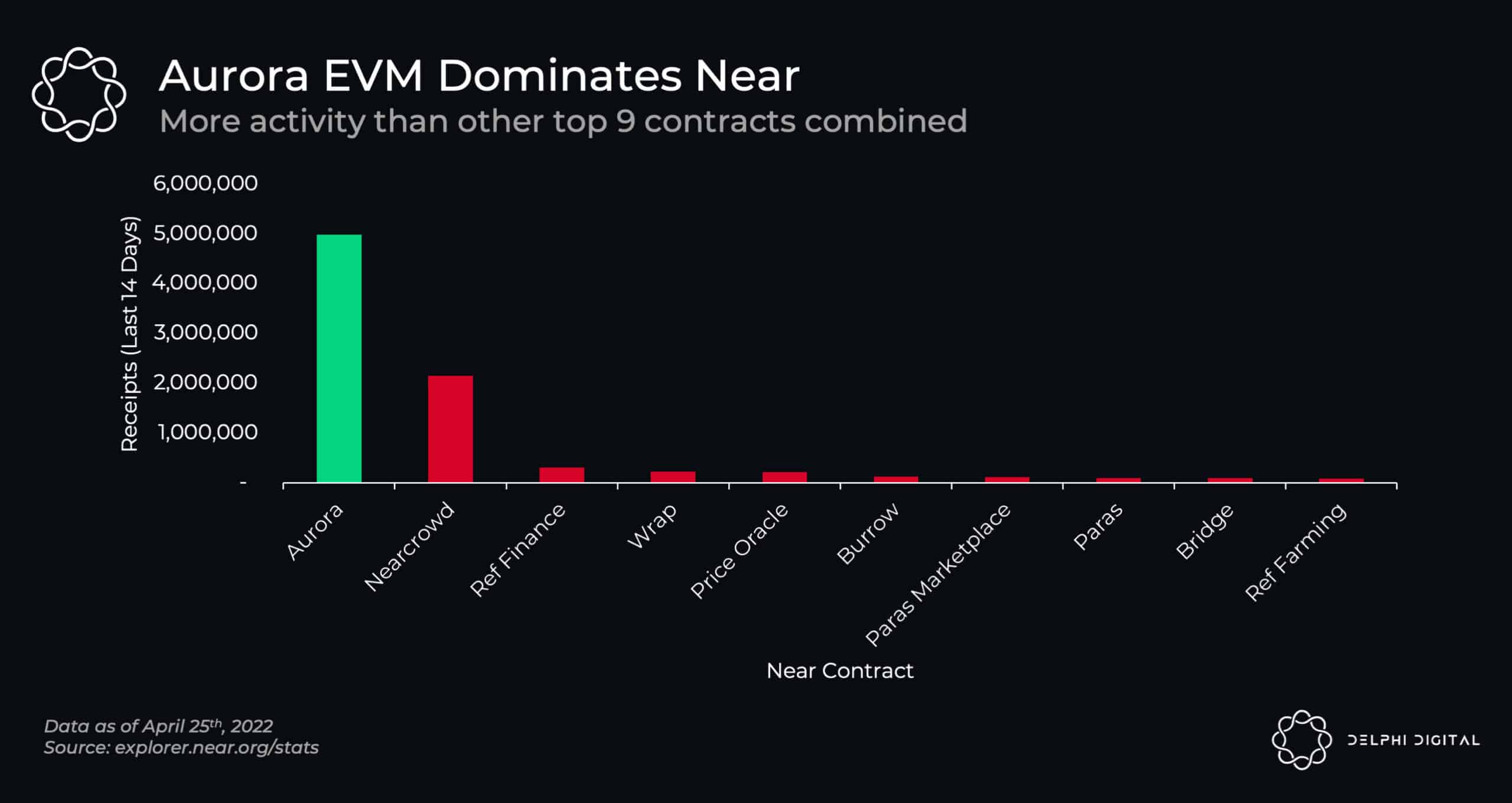
By decoupling chain execution from consensus, Aurora enables a modular approach to scaling. Projects can launch their own dedicated Virtual Chain in minutes, tailoring gas fees and parameters to their specific needs. This flexibility positions Aurora as a compelling option for developers seeking the Ethereum ecosystem’s compatibility without the associated scalability bottlenecks.
market dynamics and token utility
The current market position of Aurora EVM analysis centers on its role as the primary Ethereum-compatible layer on NEAR. This positioning creates a direct correlation between Aurora’s performance and the broader health of the NEAR ecosystem. As an EVM environment, Aurora allows developers to deploy Solidity smart contracts without rewriting code, effectively bridging Ethereum’s developer base with NEAR’s high-throughput infrastructure.
Token utility remains the engine for this alignment. The AURORA token serves dual purposes: governance and staking. Holders participate in protocol decisions, while validators stake tokens to secure the network. This mechanism ensures that network security and economic incentives are tied to the underlying NEAR chain, creating a shared risk profile.
To understand where Aurora stands relative to other EVM options, it helps to look at the technical trade-offs. The following comparison highlights how Aurora’s architecture differs from generic EVM L2s and other NEAR-based solutions.
| Metric | Aurora | Generic EVM L2 | NEAR Native |
|---|---|---|---|
| Finality | ~1-2 minutes (NEAR block time) | Varies (often <1 min) | ~1-2 minutes |
| EVM Compatibility | Full EVM (Solidity) | Full EVM | None (NEAR VM) |
| Security Model | Shared NEAR Security | Independent (e.g., Optimism/Arbitrum) | NEAR Security |
| Transaction Cost | Low (sub-penny) | Low-Medium | Low |
Strategic use cases for enterprises
Aurora’s architecture as a "mother of Virtual Chains" on NEAR Protocol creates distinct advantages for enterprises prioritizing throughput and developer familiarity. By running as smart contracts on NEAR, Aurora allows organizations to deploy fully customizable, EVM-compatible chains without the overhead of managing separate consensus layers. This setup is particularly effective for high-frequency DeFi protocols and enterprise dApps that require low-latency transaction finality.
The infrastructure supports dynamic environments where developers can leverage existing Ethereum tooling while benefiting from NEAR’s sharding capabilities. For businesses, this means they can decentralize their product operations without rewriting codebases or migrating away from the Solidity ecosystem. The result is a scalable environment that maintains Ethereum compatibility while offering the speed necessary for real-time financial applications.
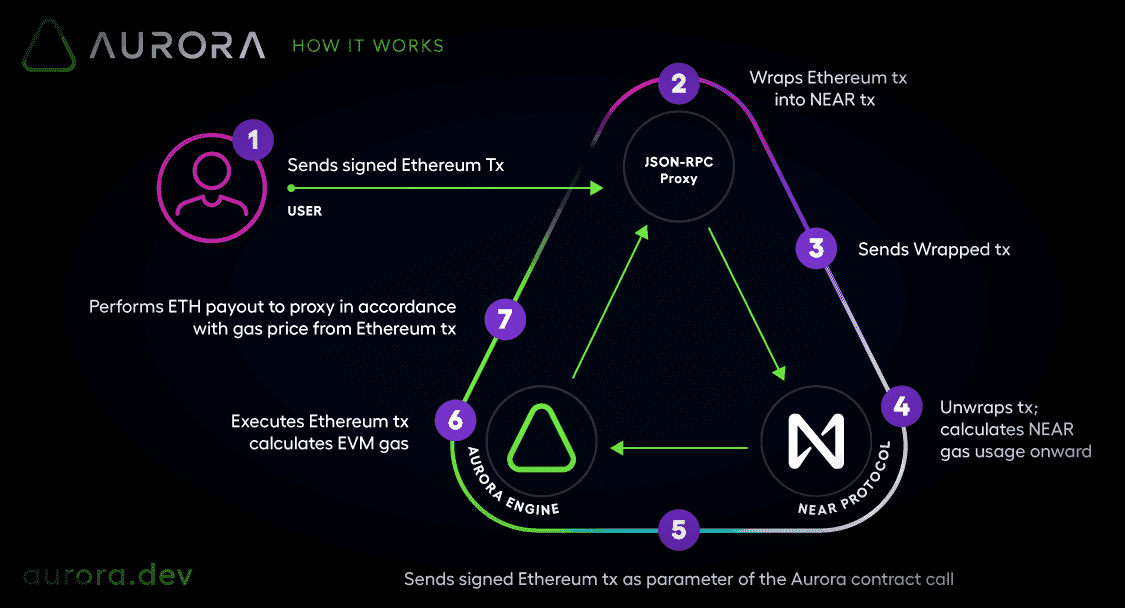
This approach reduces the friction typically associated with cross-chain interoperability. Enterprises can launch isolated virtual chains for specific use cases—such as supply chain tracking or high-volume microtransactions—while still participating in the broader NEAR ecosystem. The ability to quickly establish these environments allows for rapid iteration and deployment, which is essential in competitive market sectors.
For the Aurora EVM analysis, this structural flexibility positions the network as a strong candidate for institutional adoption. The combination of EVM parity and NEAR’s underlying scalability offers a practical path for enterprises to experiment with blockchain infrastructure without incurring the high gas fees or latency issues common on mainnet Ethereum.
Developer onboarding checklist
Before committing code to the mainnet, use this Aurora EVM analysis of your own workflow to ensure compatibility and cost-efficiency. The platform runs a high-performance, pure Rust implementation of the EVM, which means standard Ethereum tooling works out of the box, but deployment economics differ. Follow these steps to validate your build.
Aurora is built on NEAR Protocol. Ensure your development environment supports NEAR wallet signatures for transaction signing. Test the connection using the official Aurora SDK to confirm that your local node can correctly relay transactions to the NEAR network without latency issues.
Deploy your smart contract to the Aurora testnet first. Verify that your Solidity code compiles without errors and that gas estimates align with Aurora’s specific pricing model. This step catches compatibility issues with NEAR-specific features before they hit production.

Review your contract’s gas usage against Aurora’s base fee structure. Unlike some chains, Aurora’s gas dynamics can vary based on NEAR network congestion. Perform a security audit focusing on reentrancy and access control, as the underlying Rust EVM implementation requires strict adherence to standard EVM security practices.
Use the chart above to correlate Ethereum network congestion with potential Aurora gas fluctuations. Since Aurora’s EVM mirrors Ethereum’s execution layer, major ETH gas spikes often signal similar pressure on Aurora, helping you time your mainnet deployments for lower costs.
common questions about aurora evm analysis
Investors often confuse Aurora’s technical infrastructure with broader market movements or unrelated entities. This section clarifies the distinction between Aurora’s EVM environment and BNB Smart Chain, addresses valuation metrics for Aurora Innovation (the enterprise software company sharing the ticker), and outlines the speculative nature of cryptocurrency price recovery.
will the aurora coin ever recover?
Market analysts project that the AURORA token could potentially reach prices between $1.93 and $2.88 over the next 3 to 5 years, assuming favorable macroeconomic conditions and sustained adoption of its scaling solutions. However, these projections are highly speculative. The cryptocurrency market remains volatile, and past performance does not guarantee future results. Recovery depends on broader Ethereum ecosystem health and Aurora’s ability to maintain its developer base.
is aurora innovation undervalued?
It is important to distinguish Aurora EVM (the blockchain) from Aurora Innovation (the enterprise software company, ticker: AUR). Financial assessments of Aurora Innovation suggest a fair value of approximately $9.79, labeling the stock as undervalued relative to its current price. However, this bullish narrative faces significant headwinds, including a tiny revenue base of $3 million and a substantial net loss of $816 million. These financials could necessitate additional share issuance, potentially diluting shareholder value.
is evm the same as bnb?
No. EVM (Ethereum Virtual Machine) is a runtime environment that allows smart contracts to be executed. BNB Smart Chain (formerly Binance Smart Chain) is a specific blockchain network that is compatible with the EVM. Aurora is also EVM-compatible. While they share this technical standard, they are distinct networks with different consensus mechanisms, governance structures, and ecosystems. Aurora operates as a Layer 2 scaling solution for Ethereum, whereas BNB Smart Chain operates as its own independent Layer 1 chain.
No comments yet. Be the first to share your thoughts!