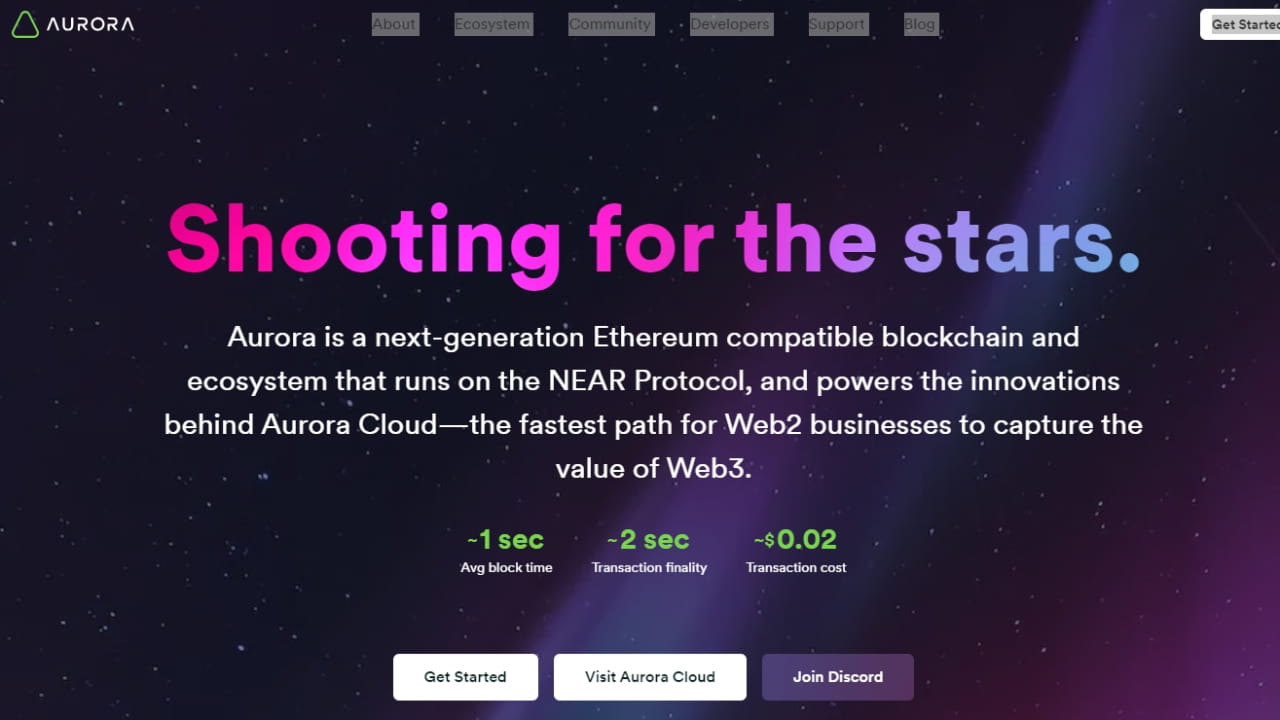
Aurora EVM infrastructure overview
Aurora operates as a pure Rust implementation of the Ethereum Virtual Machine (EVM) deployed directly on the NEAR blockchain. This architecture allows it to function as a "virtual chain," meaning the EVM logic runs as a smart contract rather than requiring a separate, independent consensus layer. For developers, this means writing standard Solidity code works exactly as it does on Ethereum, but the underlying execution benefits from NEAR’s sharding and speed.
The technical foundation is built on a high-performance Rust engine designed for security and efficiency. By leveraging NEAR’s Proof-of-Stake consensus, Aurora inherits the network’s finality and throughput capabilities. This setup avoids the heavy overhead of maintaining a separate validator set, allowing the chain to scale horizontally as the NEAR network grows.
Aurora’s identity is defined by this seamless integration. It is not a sidechain in the traditional sense but an EVM-compatible environment that lives within NEAR’s ecosystem. This approach offers developers the familiarity of Ethereum tooling combined with the scalability and low transaction costs inherent to the NEAR protocol.
Virtual chains and NEAR convergence
Aurora does not fit the standard definition of a Layer 2 rollup. Instead of processing transactions off-chain and posting compressed data to Ethereum, Aurora operates as a network of virtual chains that run directly as smart contracts on the NEAR Protocol. This architectural choice fundamentally shifts how scalability is achieved, leveraging NEAR’s native sharding rather than relying on sequencers or data availability layers typical of other EVM scaling solutions.
The core innovation lies in the "virtual" nature of these chains. Each virtual chain is an independent EVM-compatible environment that executes transactions on NEAR’s shard structure. This allows developers to spin up fully customizable, high-throughput networks without the complexity of managing separate validator sets or bridging assets across disparate consensus mechanisms. The result is an EVM experience that inherits NEAR’s high TPS and low fees while maintaining direct access to the underlying shard-based security.
This convergence with NEAR’s sharding technology means Aurora’s scalability is not capped by Ethereum block space. As NEAR’s network grows and adds more shards, Aurora’s virtual chains automatically benefit from increased throughput. This creates a scalable foundation for the Aurora EVM analysis, offering a path to mass adoption that avoids the congestion bottlenecks often seen in traditional L2 environments.
Ecosystem momentum and developer tools
Aurora’s primary value proposition lies in its ability to bridge Ethereum’s mature developer ecosystem with NEAR’s high-throughput infrastructure. By operating as an EVM-compatible layer-2 solution, Aurora allows existing Ethereum dApps and users to migrate with minimal friction. This compatibility is not just a technical feature but a strategic lever, enabling developers to leverage the vast library of Ethereum tools while benefiting from NEAR’s speed and lower costs. The ecosystem momentum is evident in the growing number of projects choosing this path, signaling confidence in Aurora’s role as a scaling layer for 2026.
To support this migration, Aurora provides a robust suite of developer tools, with Aurorascan serving as the central hub. Functioning as the equivalent of Etherscan but optimized for the Aurora network, Aurorascan offers full transparency into transaction history, contract verification, and token analytics. For developers, this means they can deploy, verify, and monitor smart contracts with the same familiarity they would expect on Ethereum mainnet, reducing the learning curve and operational risk. The reliability of these tools is critical for high-stakes financial applications, ensuring that data integrity remains uncompromised as the network scales.
Market sentiment around the Aurora EVM analysis often hinges on the health of its native token, AURORA. As the network attracts more dApps and users, the demand for AURORA to pay for gas and participate in governance naturally increases. The current market dynamics reflect this potential, with the token price serving as a real-time indicator of ecosystem confidence. Investors and developers alike watch these metrics closely, as sustained growth in active addresses and transaction volume typically precedes broader adoption.
Strategic outlook for 2026
The path to 2026 requires Aurora to solidify its position as the primary EVM bridge on NEAR Protocol. Success depends on maintaining high throughput while keeping transaction costs negligible for everyday users. As Ethereum scaling remains a competitive space, Aurora’s unique architecture offers a distinct advantage by leveraging NEAR’s sharding capabilities rather than relying solely on Layer 2 rollups.
Market sentiment will likely hinge on ecosystem adoption. If developers continue to migrate Solidity-based applications to Aurora, the network’s utility will grow independently of short-term price volatility. The $100 million initial funding provided a strong foundation, but long-term viability now rests on sustained user engagement and interoperability with other chains. Phemex notes that Aurora’s staking and governance mechanisms are central to this growth, allowing token holders to participate in network security.
Investors should monitor the AURORA token’s performance alongside broader crypto market trends. While the token has shown minor daily fluctuations, such as a recent 0.73% gain, the long-term trajectory is tied to NEAR’s overall health. A robust Aurora ecosystem signals confidence in NEAR’s hybrid sharding technology, potentially driving demand for both tokens.
The following checklist outlines key factors to watch as the 2026 horizon approaches:
- Ecosystem Growth: Track the number of active dApps and total value locked (TVL) on Aurora.
- NEAR Integration: Monitor improvements in cross-chain communication between NEAR and Ethereum.
- Regulatory Clarity: Watch for global regulations affecting EVM-compatible Layer 2 solutions.
- Token Utility: Assess whether staking rewards and governance participation are increasing.
-
Ecosystem Growth: Track the number of active dApps and total value locked (TVL) on Aurora.
-
NEAR Integration: Monitor improvements in cross-chain communication between NEAR and Ethereum.
-
Regulatory Clarity: Watch for global regulations affecting EVM-compatible Layer 2 solutions.
-
Token Utility: Assess whether staking rewards and governance participation are increasing.
Aurora evm market: what to check next
Investors looking at Aurora EVM analysis often pause at the volatility inherent to Layer 2 scaling solutions. While the technology offers Ethereum compatibility on the NEAR blockchain, the token’s price action remains tightly coupled with broader crypto sentiment and specific ecosystem adoption metrics. Understanding these dynamics is essential for anyone evaluating the asset’s viability in 2026.
Recent market movements show AURORA trading around £0.018, reflecting modest short-term gains. However, long-term investment potential hinges less on daily fluctuations and more on whether Aurora can secure sustained developer activity and user volume against competing L2s. The following questions address the most common concerns regarding price stability and fundamental value.
No comments yet. Be the first to share your thoughts!