Aurora EVM market overview
Aurora has carved out a distinct niche as the first fully EVM-compatible network running on NEAR Protocol. This architecture allows Ethereum developers to deploy smart contracts without rewriting code, while leveraging NEAR’s sharded infrastructure for higher throughput. The result is a low-cost environment that maintains Ethereum tooling compatibility, appealing to projects seeking scalability without abandoning the EVM ecosystem.
The market has responded to this technical positioning with notable volatility. Recent trading activity has shown significant price swings, including periods where the token experienced sharp increases followed by consolidation. This behavior reflects the broader crypto market's sensitivity to layer-2 narratives and the specific adoption metrics of the NEAR ecosystem.
For investors and developers, the current price action serves as a barometer for Aurora's real-world utility. The token's performance is closely tied to the growth of dApps migrating from Ethereum and the overall health of the NEAR network. Understanding these dynamics is essential for assessing whether Aurora can sustain its position as a viable scaling solution.
Technical analysis of AURORA/USD reveals key support and resistance levels that traders are watching closely. The chart below illustrates recent price movements and volume trends, providing context for the token's current market sentiment.
Infrastructure and virtual chains
Aurora’s technical foundation rests on two distinct pillars: a native, high-performance EVM implementation and a unique virtual chain architecture built on NEAR Protocol. This combination aims to resolve the scalability bottlenecks that typically plague Ethereum Layer 2 solutions, offering a pathway for developers to deploy Ethereum-compatible applications with significantly higher throughput.
At the core of this infrastructure is Aurora EVM, a pure Rust implementation of the Ethereum Virtual Machine. Unlike many competitors that rely on wrapped versions of existing EVM clients like Geth or Erigon, Aurora built its execution layer from the ground up. This choice allows for tighter integration with the NEAR network and provides a more secure, efficient runtime environment. The use of Rust ensures memory safety and performance, which are critical for handling the high transaction volumes expected on a scalable L2 network.
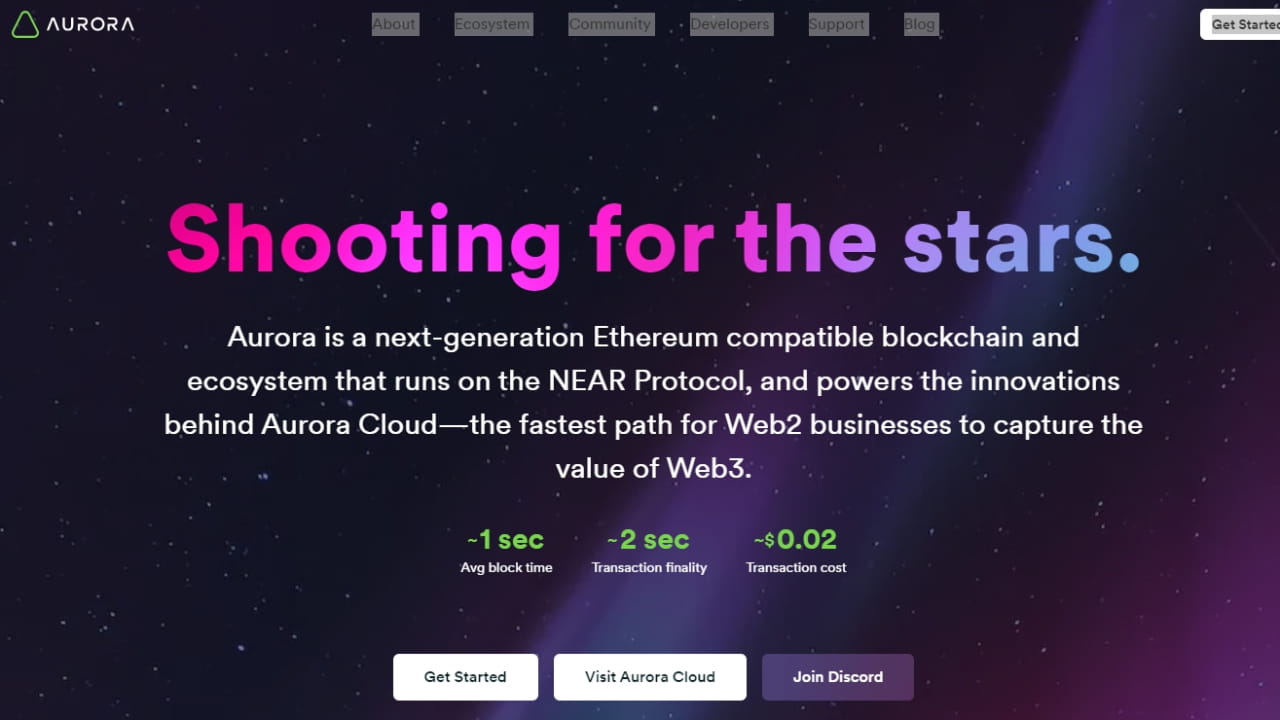
Aurora EVM is a high-performance, pure Rust implementation of the Ethereum Virtual Machine (EVM). Designed for security, efficiency, and full Ethereum compatibility, it serves as the execution layer for Aurora's virtual chains.
The virtual chain model further differentiates Aurora. These are fully customizable, EVM-compatible chains that run as smart contracts on the NEAR blockchain. Each virtual chain operates independently, allowing developers to tailor consensus mechanisms, fee structures, and governance models to their specific needs. This flexibility enables a multi-chain ecosystem where different applications can coexist without competing for the same block space, effectively multiplying the network's overall capacity.
Developer migration and tooling
For Ethereum developers, Aurora offers a familiar entry point into the NEAR ecosystem without requiring a rewrite of existing codebases. Because Aurora is fully EVM-compatible, it supports Solidity and Vyper smart contracts, as well as standard development stacks like Hardhat, Foundry, and Remix. This compatibility means you can deploy your existing contracts to Aurora with minimal friction, treating it largely as another execution layer.
The primary technical advantage lies in the underlying infrastructure. Aurora runs as a smart contract on NEAR Protocol, leveraging NEAR’s sharding capabilities to achieve higher throughput and lower latency than many standalone EVM chains. For developers, this translates to faster finality and significantly reduced gas costs. While Ethereum mainnet can experience congestion during peak times, Aurora’s architecture provides more predictable transaction fees, which is particularly beneficial for high-frequency applications or micro-transactions.
To compare the practical impact of this infrastructure, consider the differences in gas efficiency and finality times between Aurora and Base Ethereum L1.
| Feature | Aurora | Base Ethereum L1 |
|---|---|---|
| Smart Contract Language | Solidity, Vyper | Solidity, Vyper |
| Underlying Layer | NEAR Protocol (Sharded) | Ethereum L1 |
| Transaction Finality | Seconds | Minutes to Hours |
| Gas Costs | Very Low | Variable (Often High) |
Tooling support extends beyond just the compiler. Aurora provides dedicated documentation and SDKs to help developers bridge assets between Ethereum and Aurora, as well as integrate with NEAR’s account model if they wish to leverage its unique features. This hybrid approach allows developers to maintain their Ethereum-centric workflows while accessing the scalability benefits of a sharded environment. The result is a migration path that feels less like a leap into the unknown and more like an upgrade to an existing, more efficient engine.
Tokenomics and Staking Dynamics
Aurora’s economic model is tightly coupled with the NEAR Protocol, creating a hybrid incentive structure that balances Ethereum compatibility with NEAR’s high-throughput requirements. The native AURORA token serves as the primary utility asset, facilitating transaction fees, governance voting, and network security through staking. Unlike standalone Layer 2 solutions that issue their own security tokens, Aurora’s value accrual is deeply integrated into the broader NEAR ecosystem, meaning its economic health is often a reflection of NEAR’s overall network activity and adoption.
Staking is the cornerstone of Aurora’s security and governance. Users can stake AURORA tokens to help secure the network and participate in on-chain governance decisions. The staking mechanism allows token holders to earn rewards derived from transaction fees generated on the Aurora EVM. This creates a direct feedback loop: as developer activity and user volume increase on Aurora, transaction fees rise, potentially increasing the yield for stakers. However, because Aurora operates as an EVM environment on NEAR, the specific staking rewards and inflation rates are subject to the broader NEAR protocol’s monetary policy adjustments, adding a layer of complexity for investors tracking pure Aurora yields.
Governance on Aurora is decentralized, with AURORA holders having the power to vote on parameter changes, protocol upgrades, and treasury allocations. This on-chain governance model ensures that the network’s evolution is driven by its community rather than a central foundation. For institutions and developers evaluating Aurora’s market fit, understanding this governance dynamic is critical. It determines how quickly the network can adapt to technical challenges or incorporate new features like enhanced ZK-proofs or cross-chain bridges. The ability to influence protocol parameters directly through token voting is a significant factor in the long-term viability and decentralization of the Aurora EVM infrastructure.
Ecosystem momentum and risks
Use this section to make the Aurora EVM Analysis decision easier to compare in real life, not just on paper. Start with the reader's actual constraint, then separate must-have requirements from details that are merely nice to have. A practical choice should survive normal use, maintenance, timing, and budget. If a recommendation only works in an ideal situation, call that out plainly and give the reader a fallback path.
The simplest way to use this section is to write down the must-have criteria first, then compare each option against those criteria before weighing nice-to-have features.
No comments yet. Be the first to share your thoughts!