What makes Aurora distinct
Aurora operates as a Layer 2 solution on the NEAR protocol, defined by its full EVM compatibility. This allows developers to use standard Ethereum tools like Hardhat to build and deploy dApps without learning new languages, leveraging NEAR’s high-performance sharded chain infrastructure. This bridge between Ethereum's developer ecosystem and NEAR's speed is the core of Aurora's value proposition.
The distinction lies in throughput and cost. While Ethereum mainnet often faces congestion and high gas fees, Aurora leverages NEAR's sharding technology to process transactions significantly faster and cheaper. It uses ETH as the base fee token, maintaining the economic model Ethereum users expect while removing the friction of mainnet congestion. This setup allows for high-throughput applications that would be prohibitively expensive on Layer 1 Ethereum.
This architectural choice positions Aurora as a scalable alternative that prioritizes developer ease of migration. By keeping the EVM interface identical, it lowers the barrier to entry for Ethereum projects seeking to scale without rebuilding their entire stack. The result is a network that combines the security and familiarity of Ethereum with the speed and cost-efficiency of a modern Layer 2.
How the NEAR bridge works
To understand Aurora’s value proposition, look at its bridge. This is the active mechanism that translates Ethereum's security into NEAR's speed. The bridge operates as a virtual chain, meaning it doesn't just move tokens—it moves the entire state of the EVM.
1. Locking Assets on Ethereum
The process begins on Ethereum, the more expensive and slower layer. When you want to move assets like ETH or ERC-20 tokens to Aurora, you don't send them directly to a new address. Instead, you approve and lock them in a smart contract on Ethereum. Think of this as a vault: the assets are still there, secured by Ethereum's massive hash rate, but they are frozen and unavailable for use on the main chain.
2. Minting on NEAR
Once the Ethereum transaction is confirmed, the bridge detects the lock event. It then triggers a corresponding action on the NEAR blockchain. Here, the bridge mints a 1:1 representation of the locked assets on Aurora. This is where the efficiency happens: because NEAR uses Nightshade sharding, this minting happens in seconds, not minutes. You now hold "wrapped" tokens on Aurora that are fully functional within the EVM environment.
3. Using Aurora’s EVM Environment
With assets minted on Aurora, you can interact with decentralized applications (dApps) as if you were on Ethereum. Smart contracts execute instantly, and gas fees are a fraction of a cent. This is the primary use case: high-frequency trading, gaming, or complex DeFi operations that would be prohibitively expensive on Ethereum mainnet. The EVM compatibility ensures that your existing tools, wallets, and codebases work without change.
4. Burning and Unlocking
When you want to return your assets to Ethereum, the process reverses. You send the wrapped tokens on Aurora back to the bridge contract, which burns them (destroying them permanently). This burn event signals the Ethereum side of the bridge to use the original assets from the vault and send them back to your Ethereum wallet. The entire cycle maintains a strict 1:1 peg because every token on Aurora is backed by a locked token on Ethereum.


As an Amazon Associate, we may earn from qualifying purchases.
This architecture creates a unique trade-off. You gain the speed and low cost of NEAR, but you inherit NEAR's security model for the bridge itself. If NEAR's consensus were compromised, the bridge's security would be at risk. However, for most users, the benefit of accessing Ethereum's liquidity with NEAR's performance is a significant upgrade in efficiency.
Key tools for builders
Aurora’s value proposition rests on its full EVM compatibility. This means the development workflow remains identical to Ethereum, removing the friction of learning new languages or frameworks. You can deploy existing Solidity smart contracts without modification, leveraging the same tooling ecosystem that powers the largest DeFi and NFT markets.
Hardhat and Foundry
For compilation, testing, and deployment, Aurora supports standard Ethereum toolchains out of the box. Hardhat users can configure the hardhat.config.js to point to Aurora’s RPC endpoints, while Foundry developers can deploy directly via forge create. This parity ensures that your local development environment mirrors production conditions closely, reducing deployment risks. Official documentation provides specific configuration guides for both tools to ensure seamless integration.
Wallet Integration
Interacting with Aurora requires a wallet that supports EVM addresses. Most major wallets, including MetaMask and Zerion, allow you to add Aurora as a custom network. Once added, your existing Ethereum address functions identically on Aurora, holding AURORA tokens and interacting with dApps. This compatibility allows users to access Aurora’s DeFi ecosystem without migrating assets to a new chain or learning new key management practices.
Cost and Speed Comparison
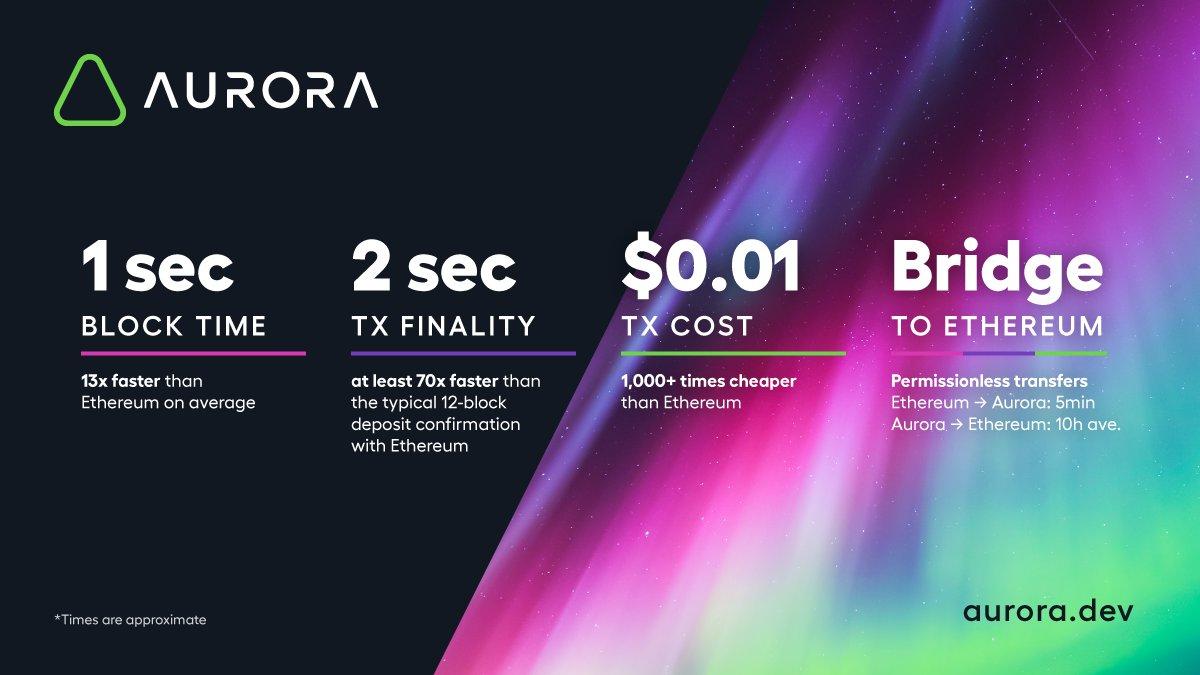
The technical advantage of Aurora extends beyond tooling. By running on the NEAR network, Aurora offers significantly lower gas fees and faster finality compared to Ethereum Mainnet. This efficiency is critical for builders deploying high-frequency trading bots or NFT minting contracts where transaction costs can otherwise erode margins.
| Network | Avg Gas Cost | Finality Time |
|---|---|---|
| Aurora | <$0.01 | ~1-2s |
| Ethereum Mainnet | $1-$10+ | ~12-15m |
| Arbitrum One | <$0.10 | ~10-15m |
| Optimism | <$0.10 | ~10-15m |
Aurora EVM Market Trends and Price Action
Aurora’s position in the broader crypto market remains closely tied to the health of the NEAR ecosystem and general Ethereum Layer 2 sentiment. While the EVM compatibility offers developers a familiar entry point, the AURORA token itself has experienced significant volatility, reflecting the challenges of maintaining liquidity in a competitive multi-chain environment. Understanding these price dynamics is essential for anyone assessing the network's current trajectory or planning long-term infrastructure investments.
The market sentiment for AURORA currently leans toward caution. Recent data suggests a "fear" index, indicating that investors are hesitant, likely due to broader macroeconomic pressures and the intense competition among EVM-compatible chains. Despite this, technical forecasts remain optimistic for the longer term, with some models predicting substantial growth by 2027. However, short-term traders should be wary of the prevailing bearish momentum and the lack of immediate breakout catalysts.
Key Technical Levels and Support
From a technical perspective, identifying support and resistance levels is critical for timing entries and exits. The AURORA/USD pair has shown resilience at certain lower bounds, but breaking above immediate resistance requires sustained volume. Traders often watch these levels to gauge whether institutional interest is returning or if the token will continue its sideways consolidation.
To visualize these movements, we use live provider-backed charts that update in real-time. This ensures you are seeing the most current price action, rather than stale data that may have already shifted.
Sentiment and Future Outlook
While short-term indicators point to fear, the underlying utility of Aurora continues to evolve. The network’s focus on cross-chain interoperability, particularly with NEAR, provides a unique value proposition that could drive future adoption. However, price action will likely remain sensitive to overall crypto market trends until Aurora can demonstrate consistent, independent growth in total value locked (TVL) and active developers.
For now, the strategy for most participants involves careful risk management. Keeping an eye on the Fear & Greed Index and major support levels can help manage uncertainty. As the market stabilizes, Aurora’s technical infrastructure may finally begin to reflect its potential in the token price.
Common setup mistakes
Even with Aurora’s EVM compatibility, small configuration errors can lead to failed transactions or loss of access to funds. The most frequent issue is using the wrong network ID in your wallet. If you connect to the wrong endpoint, your signed transactions may not broadcast correctly, leaving you wondering why your transfer is stuck.
Another common pitfall is misconfiguring RPC endpoints. Using a generic Ethereum RPC URL instead of Aurora’s specific endpoint will result in connection errors or incorrect state data. Always verify your RPC URL against the official documentation at doc.aurora.dev to ensure you are interacting with the correct chain state.
To avoid these errors, treat your wallet setup like a pre-flight check. Verify the network name, chain ID, and RPC URL before initiating any high-value transaction. A quick verification step can save hours of troubleshooting later.
-
Verify network name is "Aurora Mainnet" or "Aurora Testnet"
-
Confirm Chain ID is 1313161554 (Mainnet) or 1313161555 (Testnet)
-
Use the official Aurora RPC URL from doc.aurora.dev
-
Test with a small transaction amount before large transfers
Aurora price forecast 2025
Predicting the trajectory of Aurora (AURORA) requires balancing its technical utility as a bridge between NEAR and Ethereum against broader market volatility. Current analyst sentiment is mixed, with many forecasts suggesting a cautious recovery rather than an immediate surge. Some projections indicate potential growth, with certain models anticipating significant percentage increases over the next few years, though these are long-term estimates rather than short-term guarantees.
Market sentiment currently reflects a degree of caution, with the Crypto Fear & Greed Index often hovering in the "fear" territory. This suggests that while the underlying technology remains robust, investor confidence is still rebuilding. For traders, this environment means that price movements are heavily influenced by macroeconomic factors and Ethereum network activity rather than Aurora-specific news alone.
To track real-time performance and technical indicators, it is best to rely on live market data rather than static price predictions. The widget below provides current pricing and historical charts, allowing you to make decisions based on actual market behavior.
No comments yet. Be the first to share your thoughts!