Aurora’s virtual chain architecture
Aurora is not a standalone blockchain, nor is it a traditional Layer 2 rollup with its own sequencer and data availability layer. Instead, it is an EVM-compatible environment implemented as a smart contract on the NEAR Protocol. This distinction defines its entire infrastructure strategy: it is a "virtual chain" that borrows security and data availability from an existing L1 rather than maintaining its own separate validator set.
This architecture allows Aurora to offer full Ethereum compatibility without the overhead of bootstrapping a new consensus mechanism. Developers can deploy existing Solidity code and use familiar tooling like Hardhat or Foundry, but the execution happens within the NEAR ecosystem. The result is a chain that scales with NEAR’s high throughput while remaining fully interoperable with the Ethereum ecosystem.
The implications for infrastructure are significant. By running as a contract, Aurora avoids the fragmentation issues that often plague standalone chains. It inherits NEAR’s sharding capabilities, allowing for faster finality and lower transaction costs compared to Ethereum mainnet. This model positions Aurora as a bridge, connecting Ethereum’s vast developer base with NEAR’s scalable infrastructure.
Aurora infrastructure strengths and trade-offs
Aurora operates as a Layer 2 solution on the NEAR Protocol, effectively functioning as a "virtual chain." It is a pure Rust implementation of the Ethereum Virtual Machine (EVM), allowing developers to deploy existing Ethereum smart contracts without modification. This architecture offers the best of both worlds: the vast ecosystem of Ethereum tooling combined with NEAR’s high throughput and low transaction costs.
The primary advantage is performance. Aurora processes transactions significantly faster than Ethereum L1, with block times averaging around 1.25 seconds. Gas fees remain a fraction of a cent, making micro-transactions and high-frequency DeFi interactions economically viable. For developers, this means deploying to Aurora feels like deploying to Ethereum, but with the scalability usually reserved for purpose-built blockchains.
However, this convenience comes with a specific trade-off: reliance on NEAR’s security model. Aurora does not have its own consensus layer; instead, it inherits security from NEAR’s Nightshade sharding. While this keeps costs low, it means Aurora’s finality and security guarantees are tied to the health and decentralization of the NEAR network. Additionally, while transaction processing is fast, bridging assets between Ethereum and Aurora involves a finality latency period, requiring users to wait for cross-chain proofs to settle.
Aurora vs. Ethereum L1 vs. NEAR L2s
The following table compares Aurora’s core infrastructure metrics against Ethereum L1 and other NEAR-based L2s to highlight its positioning.
| Network | Block Time | Gas Cost | Security Model |
|---|---|---|---|
| Aurora | ~1.25s | < $0.01 | NEAR L2 |
| Ethereum L1 | ~12s | $1–$20+ | Proof-of-Stake |
| NEAR Protocol | ~1.2s | < $0.01 | Nightshade Sharding |
Essential Development Tools
Building on Aurora requires a standard Ethereum development stack. The following tools are essential for deploying and testing smart contracts on the Aurora infrastructure.


As an Amazon Associate, we may earn from qualifying purchases.
Developer tools and ecosystem momentum
Aurora’s primary advantage for builders is its "virtual chain" architecture. This approach allows developers to deploy smart contracts using standard Ethereum tooling—like Hardhat, Foundry, and Truffle—without needing to learn a new language or navigate a fragmented ecosystem. The EVM environment on Aurora mirrors Ethereum’s behavior closely, meaning code that works on Ethereum generally works here, but with significantly lower transaction costs and faster finality thanks to NEAR Protocol’s underlying infrastructure.
For teams looking to migrate, the transition is straightforward. Because Aurora is EVM-compatible, you can often point your existing deployment scripts directly at the Aurora network endpoints. This reduces the friction of entering a new chain, allowing projects to focus on product development rather than rewriting core logic. The ecosystem supports a wide range of dApps, from decentralized exchanges to lending protocols, all leveraging this shared security model.
The growing dApp ecosystem reflects this developer-friendly approach. Projects are increasingly choosing Aurora not just for cost savings, but for the ability to maintain Ethereum compatibility while accessing NEAR’s high throughput. This balance of familiarity and performance makes it a compelling choice for builders prioritizing efficiency.

Build for High Frequency and Scale
Aurora’s architecture as a "virtual chain" on NEAR isn't just a marketing label; it fundamentally changes how you approach deployment. Instead of fighting for block space on a congested mainnet, you are spinning up a dedicated, EVM-compatible environment. This distinction is critical for builders targeting high-frequency DeFi protocols or scalable gaming, where latency and throughput are the primary bottlenecks. By leveraging this infrastructure, you can achieve near-instant finality and negligible gas fees without sacrificing the tooling familiarity of the Ethereum ecosystem.
Start by mapping your application’s peak transaction volume. If your use case involves rapid state changes, such as in-game asset transfers or high-frequency trading, the virtual chain model allows you to isolate this traffic. This prevents your core application logic from being slowed down by unrelated network congestion, ensuring consistent performance regardless of broader market activity.
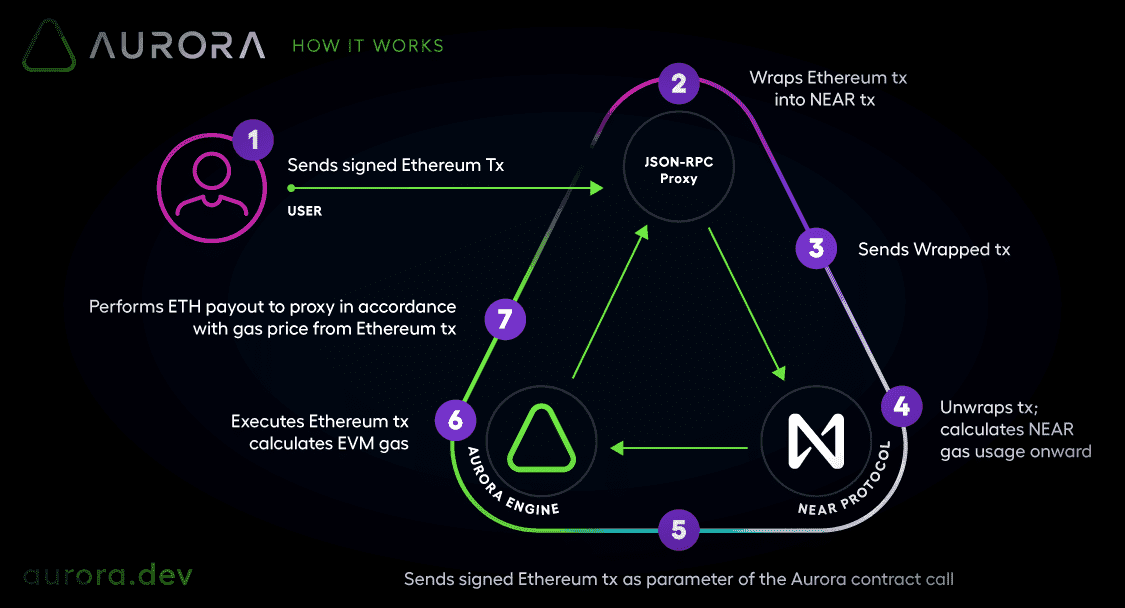
Because Aurora is fully EVM-compatible, you can deploy existing Solidity smart contracts with minimal modification. This reduces development time and allows you to utilize familiar libraries like Hardhat or Foundry. The virtual chain acts as a seamless extension of the Ethereum standard, letting you focus on application logic rather than rewriting core infrastructure in a new language.
Security remains paramount when moving assets between the base layer and your virtual chain. Aurora’s NEAR Protocol foundation provides robust security guarantees, but you must design your bridging mechanism carefully. Use official bridge contracts to ensure that asset transfers are atomic and verifiable. This step is essential for maintaining user trust, especially in DeFi applications where liquidity locks and cross-chain transfers are routine.
The strategic advantage of Aurora lies in its ability to offer specialized scalability without fragmenting the developer experience. By treating your application as a virtual chain, you gain the flexibility to optimize for specific workloads while remaining anchored to the security and composability of the broader EVM ecosystem. This approach is particularly effective for projects that require high throughput but cannot afford the complexity of building a completely new L1 from scratch.
Frequently Asked Questions About Aurora
Will the Aurora coin ever recover?
Price predictions for AURORA are inherently speculative and volatile. Rather than relying on short-term price targets, investors should focus on the underlying infrastructure. Aurora’s recovery potential is tied to its ability to attract developers to its NEAR Layer 2 environment and increase actual transaction volume, not just market sentiment.
Is EVM the same as Ethereum?
No. The Ethereum Virtual Machine (EVM) is the execution environment—the "operating system"—that runs smart contracts. Ethereum is the Layer 1 blockchain that hosts this environment. Aurora is an EVM-compatible virtual chain, meaning it uses the same development tools as Ethereum but operates as a separate Layer 2 on the NEAR Protocol, offering different speed and cost characteristics.
Is Aurora Innovation undervalued?
It is important to distinguish between the AURORA token and Aurora Innovation Inc. (AUR), a solar technology company. This analysis focuses exclusively on the AURORA cryptocurrency. The financial health and valuation of Aurora Innovation Inc. are unrelated to the performance or utility of the Aurora blockchain network.
No comments yet. Be the first to share your thoughts!