Aurora EVM infrastructure overview
Aurora operates as a high-performance Ethereum Virtual Machine (EVM) layer built on the NEAR Protocol. Unlike traditional sidechains that rely on their own consensus mechanisms, Aurora runs as a smart contract on NEAR, leveraging NEAR’s sharding and proof-of-stake security to deliver Ethereum compatibility with significantly higher throughput. This architecture allows developers to deploy existing Ethereum tools and dApps with minimal friction while benefiting from NEAR’s speed and low transaction costs.
The technical foundation is a pure Rust implementation of the EVM, as detailed in the official Aurora EVM GitHub repository. This custom build prioritizes security and efficiency, ensuring that the execution environment remains fully compatible with Ethereum standards while optimizing for the underlying NEAR blockchain. By running as a contract, Aurora achieves finality in seconds rather than minutes, addressing one of the most common bottlenecks in Ethereum Layer 2 solutions.
A key innovation is Aurora’s support for "virtual chains." These are fully customizable, EVM-compatible chains that exist as smart contracts on NEAR. Developers can spin up dedicated chains for specific applications, gaining the scalability and isolation they need without sacrificing the rich ecosystem of Ethereum tooling. This flexibility positions Aurora as a robust infrastructure layer for projects requiring high performance and tailored network configurations.
Virtual Chains and NEAR Integration
Aurora operates differently from standard Ethereum Layer 2s. Instead of relying on separate rollup sequencers or optimistic verification windows, Aurora runs as a native smart contract on the NEAR Protocol. This architecture allows developers to spin up "Virtual Chains"—fully customizable, EVM-compatible environments that function as independent entities within the NEAR ecosystem.
This approach solves the fragmentation problem inherent in the current L2 landscape. On traditional L2s, deploying a new chain often requires significant infrastructure overhead and complex bridging. Aurora’s Virtual Chains allow teams to launch dedicated EVM instances with specific parameters, such as gas token preferences, consensus mechanisms, or governance structures, all while leveraging Ethereum’s existing developer tooling. It is essentially a factory for EVM chains, where each instance is isolated yet connected to NEAR’s high-throughput base layer.
The technical advantage lies in speed and finality. Because these virtual chains are executed as NEAR smart contracts, they benefit from NEAR’s Nightshade sharding and asynchronous cross-chain contracts. This means transactions achieve near-instant finality, bypassing the multi-day dispute periods common in optimistic rollups or the latency of sequential block production in ZK-rollups. For developers, this translates to a seamless migration path: write Solidity code, deploy to Aurora, and instantly access NEAR’s scalability without rebuilding the underlying infrastructure.
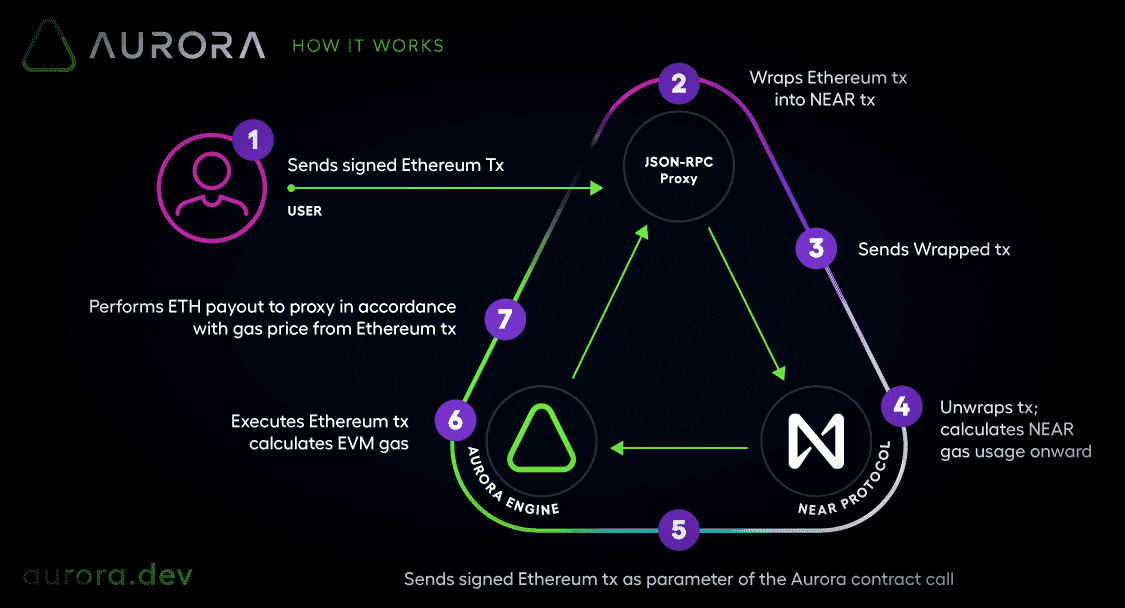
This model positions Aurora not just as another scaling solution, but as a platform for modular blockchain design. By abstracting the complexity of chain deployment, it lowers the barrier to entry for projects that need their own dedicated environment but lack the resources to build one from scratch. The result is a network where customization and scalability coexist, driven by the robust infrastructure of NEAR.
Aurora's Market Position and Tokenomics
Aurora operates as a bridge between Ethereum's vast developer ecosystem and NEAR's high-throughput infrastructure. This hybrid approach allows Ethereum Virtual Machine (EVM) smart contracts to run natively on NEAR, leveraging NEAR's sharding technology for scalability. While the technical architecture is well-documented, the market metrics reveal a project still finding its footing in a crowded Layer 2 landscape.
Current Valuation and Funding
Aurora raised approximately $100 million in its initial funding rounds, positioning it as a significant player in the early EVM-on-NEAR narrative. However, unlike traditional equities, token valuation is driven by network usage and liquidity rather than corporate earnings. The token's price action often correlates with broader Ethereum trends and NEAR ecosystem growth, making it sensitive to macro crypto cycles.
Infrastructure Comparison
To understand Aurora's competitive edge, it helps to compare its core metrics against other EVM-compatible Layer 2 solutions. While exact throughput varies based on network congestion, Aurora generally offers lower fees and faster finality than Ethereum mainnet, though it may lag behind newer zero-knowledge rollups in raw transaction capacity.
| Metric | Aurora | Arbitrum One | Optimism |
|---|---|---|---|
| Finality | ~1 minute | ~7 days (challenge period) | ~7 days (challenge period) |
| Fee Structure | Low (NEAR gas model) | Low | Low |
| Security Model | NEAR Proof-of-Stake | Ethereum DA + Fraud Proofs | Ethereum DA + Fraud Proofs |
Token Utility
The AURORA token serves as the primary utility asset for governance and network participation. Holders can stake tokens to secure the network or participate in protocol governance decisions. Unlike some Layer 2 tokens that are purely speculative, Aurora's utility is tied directly to the health and adoption of its EVM environment on NEAR. This creates a unique value proposition where success is shared between the Ethereum and NEAR ecosystems.
Migrating dApps to Aurora
Moving an Ethereum dApp to Aurora is largely a matter of configuration rather than rewriting code. Because Aurora is a fully EVM-compatible chain, the underlying Solidity smart contracts remain unchanged. You can compile your existing contracts and deploy them directly, provided you account for differences in block times and gas pricing structures.
1. Configure Your Wallet
Start by adding Aurora to your wallet as a custom network. You will need the RPC endpoint, chain ID, and currency symbol (ETH or NEAR). This step ensures your interface can interact with Aurora addresses and display balances correctly. Without this setup, your frontend will not recognize the network state.
2. Update Deployment Scripts
Modify your deployment scripts (Truffle, Hardhat, or Foundry) to point to the Aurora RPC endpoint. You do not need to change the contract code itself. However, ensure your gas limit estimates are adjusted, as block times on Aurora differ from Ethereum mainnet. This prevents deployment failures due to timeout or insufficient gas estimates.
3. Verify on Aurorascan
Once deployed, verify your contract source code on Aurorascan. This tool mirrors the functionality of Etherscan, providing a familiar interface for reading contract code and interacting with deployed instances. Verification builds trust with users by allowing them to audit the on-chain code directly. Aurorascan offers the necessary tools to confirm your deployment is live and readable.
Add the Aurora RPC endpoint, chain ID, and symbol to your wallet configuration. This enables your interface to recognize Aurora addresses and display native token balances accurately.
Point your Hardhat or Foundry scripts to the Aurora RPC. Keep the Solidity code identical, but adjust gas limit estimates to match Aurora's faster block times and lower gas costs.
Upload your source code to Aurorascan for public verification. This step confirms your contract is readable and interactive, mirroring the trust signals provided by Etherscan on Ethereum.
The transition is designed to be frictionless. By leveraging existing tooling and standard EVM compatibility, developers can focus on optimizing performance rather than managing infrastructure complexity. This approach allows teams to retain their existing workflows while accessing Aurora's throughput advantages.
Decentralization and Security Risks
Aurora operates as a sharded EVM on NEAR, a design that prioritizes speed and low costs over the immediate decentralization seen in Ethereum mainnet. This architecture creates a specific set of strategic risks that developers and investors must weigh against the performance benefits. The core tension lies in the protocol's reliance on NEAR's consensus mechanism and the centralization of its current validator set.
Validator Centralization
Currently, Aurora’s security is anchored by a limited set of validators. While this setup allows for rapid transaction finality, it means the network is not yet fully permissionless. If a small number of entities control a significant portion of the staking power, the network becomes vulnerable to collusion or single points of failure. The roadmap to full decentralization involves expanding this validator set, but until that threshold is reached, the "trust assumption" remains higher than on established L1s.
NEAR Protocol Dependency
Aurora’s existence is inextricably linked to the NEAR protocol. This dependency is a double-edged sword. On one hand, it provides robust infrastructure and shared security. On the other, any major upgrade, outage, or governance decision on NEAR directly impacts Aurora’s availability and state. A break in the NEAR chain does not just slow Aurora down; it can halt it entirely. This cross-chain risk is a critical factor in assessing Aurora’s long-term resilience compared to standalone chains.
Security Audits and Transparency
To mitigate these risks, Aurora has undergone multiple security audits from reputable firms. These audits focus on the bridge mechanisms between NEAR and Ethereum, as well as the core EVM implementation. Transparency is maintained through public reports and open-source code on GitHub. However, audits are snapshots in time; they do not guarantee immunity from future exploits, especially as the protocol evolves and new features are introduced.
Market Context
The technical risks of Aurora’s architecture are reflected in its market valuation. Investors often price in the uncertainty of its decentralization timeline. While the EVM compatibility offers a clear path for developer adoption, the premium on performance comes with the trade-off of reduced decentralization. This dynamic is visible in Aurora’s price action, which often correlates with broader NEAR ecosystem trends rather than independent Ethereum market movements.
No comments yet. Be the first to share your thoughts!