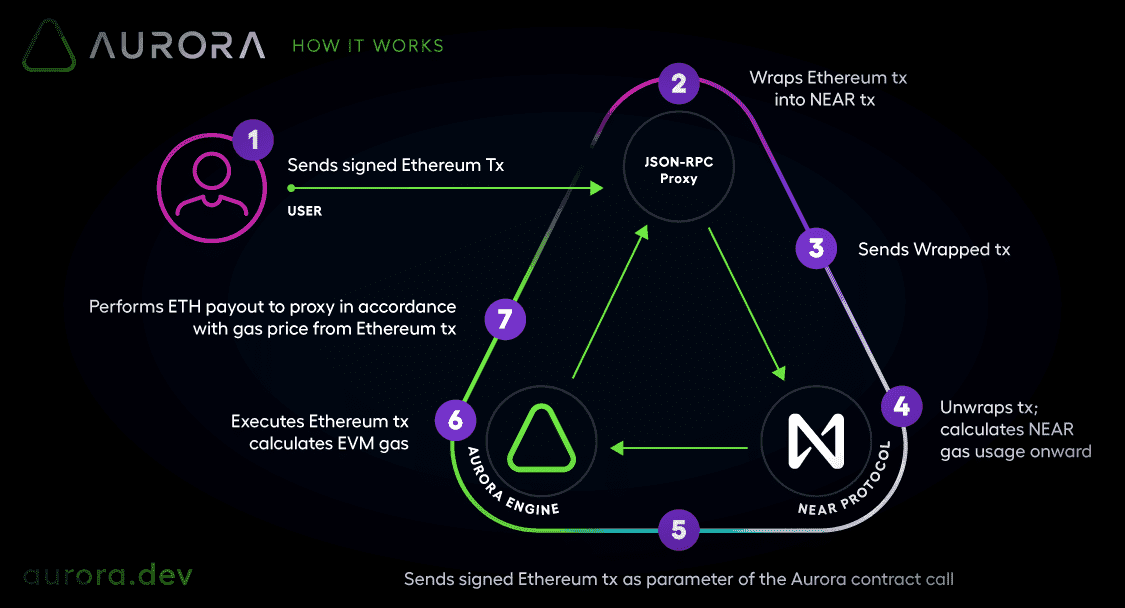
Aurora EVM infrastructure overview
Aurora EVM is not a fork of Ethereum; it is a pure Rust implementation of the Ethereum Virtual Machine running directly on the NEAR blockchain. This architectural choice shifts the heavy lifting of execution from a separate consensus layer to NEAR’s Proof-of-Stake validators. By treating smart contracts as standard NEAR account contracts, Aurora inherits NEAR’s sharding capabilities, allowing it to scale horizontally as the network grows rather than bottling up on a single chain.
The decision to write the EVM runtime in Rust prioritizes security and efficiency. Rust’s memory safety guarantees reduce the attack surface for common vulnerabilities, while the native performance of Rust code allows for faster transaction processing. This approach means developers can deploy standard Solidity contracts without modification, but they gain access to the underlying performance benefits of the NEAR ecosystem. It is a pragmatic bridge: familiar tooling for Ethereum developers, with the scalability engine of NEAR.
This infrastructure design directly impacts cost and speed. Because Aurora leverages NEAR’s block production, transactions are finalized quickly and gas fees remain low compared to Ethereum mainnet. The trade-off is that security ultimately relies on NEAR’s validator set. For applications requiring high throughput and low costs, this hybrid model offers a compelling alternative to standalone L2 rollups, though it introduces dependency on the NEAR network’s health and governance.
The result is a network that feels like Ethereum but performs with the agility of a modern L1. Developers benefit from the vast Ethereum developer ecosystem while avoiding the congestion and high fees that have plagued the base layer. This foundation sets the stage for understanding Aurora’s broader strategy: providing a scalable, EVM-compatible environment that can support complex dApps without the traditional overhead.
Market research data tools
Finding reliable data on Aurora is different from scanning Ethereum mainnet. You aren't just looking at a block explorer; you're navigating a stack that bridges EVM compatibility with NEAR's sharding. For developers and researchers, the choice of data tool dictates how quickly you can audit smart contracts or track liquidity flows.
The most common entry point is Aurorascan. As the primary block explorer, it mirrors the functionality of Etherscan but is tuned for Aurora's specific transaction types and gas mechanics. It provides the raw transparency needed to verify contract deployments and monitor wallet activity. If you are building on Aurora, this is your first stop for verifying code and checking transaction receipts.
Beyond the explorer, deeper analysis requires data indexing. Tools like Dune Analytics and Flipside Crypto allow you to query Aurora's data using SQL. This is where the real "market research" happens. Instead of just seeing a transaction hash, you can join token transfer data with liquidity pool metrics to understand user behavior across DeFi protocols on Aurora. These platforms turn raw blockchain data into dashboards that reveal trends in volume, active addresses, and token velocity.
When choosing a tool, consider what you're trying to measure. For simple verification, the explorer is sufficient. For strategic decisions, you need the aggregated data from indexing services. The table below compares the primary options available to you.
| Tool | Type | Best For |
|---|---|---|
| Aurorascan | Block Explorer | Verifying contracts, checking gas, and basic transaction tracking. |
| Dune Analytics | Data Dashboard | Complex SQL queries for DeFi trends, protocol revenue, and user behavior. |
| Flipside Crypto | Data Dashboard | Pre-built dashboards for quick insights into liquidity and token flows. |
Strategic implications for high-stakes infrastructure
Building on Aurora requires understanding its dual identity. It is an Ethereum Virtual Machine (EVM) implementation that runs on the NEAR Protocol. This architecture allows Ethereum developers to migrate smart contracts without rewriting code, while benefiting from NEAR’s shardchain infrastructure. The result is a network that processes Ethereum-style transactions with significantly lower latency and cost. However, this hybrid model introduces specific strategic considerations for teams managing high-value assets or complex dApps.
Gas fee structures and migration costs
The most immediate advantage of Aurora is its fee structure. Unlike Ethereum mainnet, where gas prices fluctuate wildly based on network congestion, Aurora’s fees are denominated in NEAR. This provides predictable, low-cost transactions that scale with NEAR’s throughput. For high-frequency trading platforms or gaming applications, this stability is critical for user experience and operational budgeting. Migrating from Ethereum involves accounting for these structural differences in gas estimation and transaction finality.
Security models and infrastructure risks
Security on Aurora is anchored by NEAR’s consensus mechanism, but it operates as a bridge-based system. Funds are locked on Ethereum and minted on Aurora, relying on a light client verification process. This introduces a unique risk vector: the security of Aurora is tied to the integrity of the NEAR light client and the bridge contracts. For high-stakes infrastructure, teams must audit these bridge mechanisms thoroughly. A compromise in the bridge or the underlying NEAR consensus could impact the integrity of assets on Aurora, even if the smart contracts themselves are secure.
Market strategy and developer alignment
Aurora’s market strategy focuses on bridging the Ethereum developer ecosystem with NEAR’s scalability. This creates a unique value proposition for projects seeking Ethereum compatibility without the mainnet’s bottlenecks. However, it also means competing for attention within both ecosystems. Teams should evaluate whether their user base prioritizes Ethereum’s liquidity and security or Aurora’s speed and cost. The decision to build on Aurora is not just technical; it is a strategic bet on the convergence of these two distinct blockchain architectures.
Price action and market sentiment
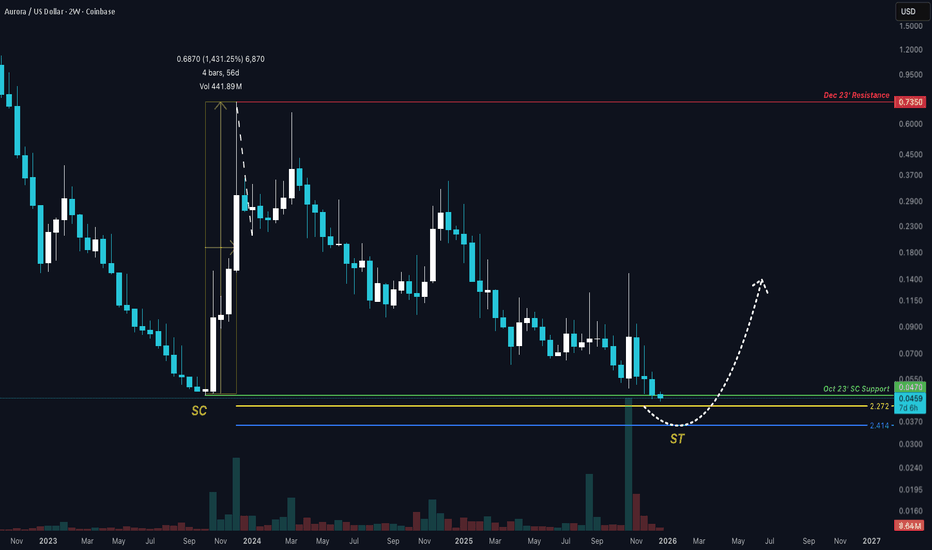
Aurora’s market trajectory is closely tied to the broader NEAR ecosystem and Ethereum’s gas fee fluctuations. As an EVM scaling solution, AURORA serves as a bridge, meaning its utility—and consequently its price—often reacts to shifts in both networks. When Ethereum mainnet congestion drives up costs, developers frequently migrate activity to Aurora’s lower-cost environment, creating natural buy pressure for the token.
To track this dynamic without relying on stale data, we use live provider-backed widgets. These tools reflect real-time liquidity and trading volume, offering a clearer picture of current market sentiment than historical snapshots.
The token’s recent performance shows resilience despite broader market volatility. Traders often watch the 24-hour volume spikes as indicators of upcoming directional moves, especially during major NEAR Protocol upgrades or Ethereum network updates. Understanding these correlations helps developers and investors anticipate short-term trends rather than reacting to them after the fact.
Essential Aurora development tools
Building on Aurora means working within a unique architecture: EVM-compatible virtual chains running as smart contracts on NEAR. This setup offers scalability, but it demands a specific toolkit to plan around the bridge between Ethereum standards and NEAR’s high-throughput environment.
Start with the core infrastructure. The Aurora IDE provides the foundational environment for deploying and managing these virtual chains. For local development, standard Ethereum toolchains like Hardhat or Foundry work directly, but you’ll need to configure your RPC endpoints to point to Aurora’s network rather than mainnet Ethereum. This ensures your transactions are processed on the correct virtual chain.
For testing, prioritize tools that simulate the bridge latency and finality differences. The Aurora GitHub repository hosts official SDKs and testing scripts that help you verify contract interactions across the NEAR-Ethereum boundary. Don’t rely solely on local testnets; use these resources to stress-test how your contracts behave when bridging assets or messages.
Security is non-negotiable. Since you’re interacting with both ecosystems, use hardware wallets that support EVM-compatible networks to sign transactions securely. Keep your private keys isolated from your development environment to prevent accidental exposure during testing.


As an Amazon Associate, we may earn from qualifying purchases.
Frequently asked questions about Aurora
Is Aurora the same as Ethereum?
Aurora is not Ethereum, but it is fully compatible with it. It is a high-performance, pure Rust implementation of the Ethereum Virtual Machine (EVM) running on the NEAR Protocol src-serp-2. This means it processes Ethereum-style transactions and supports existing Ethereum tools, but it benefits from NEAR’s superior throughput and lower fees src-serp-4.
Is EVM the same as ETH?
No. ETH is the native cryptocurrency of the Ethereum network. The EVM (Ethereum Virtual Machine) is the runtime environment that executes smart contracts. Think of ETH as the fuel and the EVM as the engine. Aurora replicates the engine (EVM) but runs it on a different chassis (NEAR), allowing it to process transactions more efficiently than the original Ethereum mainnet.
What happened to Aurora Crypto today?
Market prices for AURORA fluctuate constantly based on trading volume and broader crypto sentiment. For the most current valuation, please refer to the live market data widget above, which tracks real-time price action and technical indicators.
No comments yet. Be the first to share your thoughts!