How Aurora EVM Architecture Works
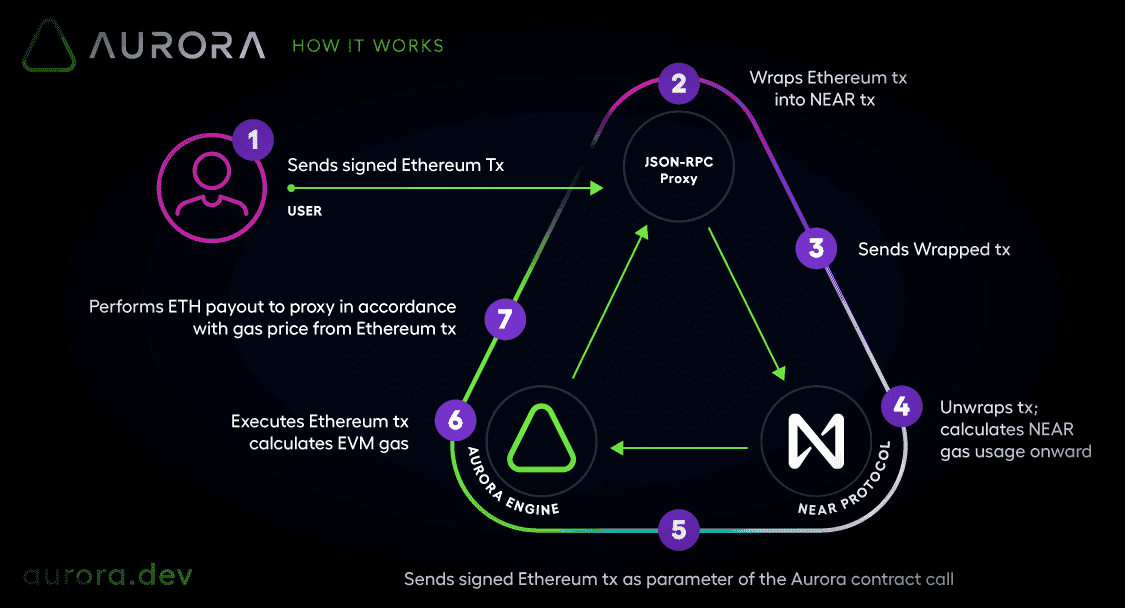
Aurora operates differently from traditional layer-2 solutions like Arbitrum or Optimism. Instead of running as a standalone blockchain with its own sequencer and validator set, Aurora functions as a smart contract deployed directly on the NEAR Protocol. This architectural choice means Aurora is effectively a "virtual chain"—a highly optimized execution environment that leverages NEAR’s underlying consensus and data availability layers.
This contract-level approach changes how developers interact with the network. While standard EVM chains require managing their own block production, Aurora delegates this heavy lifting to NEAR’s Nightshade sharding technology. The result is a high-performance, pure Rust implementation of the Ethereum Virtual Machine (EVM) that maintains full compatibility with Ethereum tooling, including MetaMask and Hardhat, without the overhead of a separate chain’s infrastructure.
For builders, this distinction is critical. Aurora isn't just an EVM wrapper; it is a specialized execution layer that inherits NEAR’s speed and finality. By running as a contract, Aurora can tap into NEAR’s account model and storage mechanisms, allowing for features like account abstraction and near-instant finality that are difficult to achieve on standalone chains. This setup offers a unique middle ground: the developer experience of Ethereum with the scalability and cost efficiency of a modern L1.
To understand the broader context of this architecture, it helps to look at the asset securing the network. NEAR’s market performance often influences the perceived stability and adoption of its ecosystem projects, including Aurora.
Key developer tools and SDKs
Aurora’s primary advantage for builders is its EVM compatibility, which means you can deploy existing Ethereum code with minimal changes. The ecosystem supports standard development frameworks like Hardhat and Foundry, allowing teams to leverage their current workflows rather than learning a new stack from scratch. This compatibility extends to RPC endpoints, which mirror Ethereum’s JSON-RPC interface, ensuring that tools like MetaMask and standard wallet integrations work out of the box.
The infrastructure is built on NEAR Protocol, running as smart contracts rather than a traditional blockchain. This architecture enables virtual chains that offer high throughput and low fees while maintaining the security guarantees of the underlying NEAR network. For developers, this means accessing scalability without sacrificing the developer experience familiar to the Ethereum community.
While the technical foundation is robust, the ecosystem is still maturing. The gap between Aurora’s L2 and Ethereum’s L1 is narrowing in terms of developer tooling, but Aurora still benefits from its unique position as a high-performance EVM environment. Builders should evaluate the trade-offs between the established liquidity of Ethereum and the cost-efficiency of Aurora’s virtual chain architecture.

Aurora Tokenomics and Market Position
The AURORA token serves as the economic backbone of the Aurora EVM, a scaling solution built on the NEAR Protocol. Unlike Ethereum’s native ETH, AURORA is specifically designed to bridge Ethereum’s Solidity ecosystem with NEAR’s high-throughput infrastructure. This distinction is critical for developers and investors, as the token’s utility is tied to the health and adoption of the NEAR-Aurora bridge rather than the Ethereum mainnet itself.
Governance and security are the primary functions of the token. Holders can stake AURORA to participate in the network’s governance decisions, influencing protocol upgrades and parameter adjustments. Additionally, staking plays a role in the network’s security model, incentivizing validators to maintain the integrity of the EVM environment. This dual role—governance and security—creates a baseline demand for the token among active participants in the Aurora ecosystem.
Market performance for AURORA is closely correlated with broader crypto market trends and the specific adoption metrics of the NEAR ecosystem. As an EVM-compatible chain, Aurora’s value proposition relies on attracting Ethereum developers who seek lower transaction costs and faster finality. The token’s market capitalization and trading volume reflect investor sentiment toward this specific niche of Layer 2 and sidechain solutions.
The token’s design aims to balance decentralization with scalability. By leveraging NEAR’s sharding technology, Aurora can process transactions more efficiently than many traditional Ethereum Layer 2s. However, this dependency on NEAR’s underlying infrastructure means that AURORA’s long-term viability is intertwined with NEAR’s own technological advancements and market performance.
Choosing the Right Chain for Your App
Aurora EVM isn’t a universal replacement for Ethereum mainnet; it’s a specialized tool for specific architectural needs. The network’s unique position as a virtual chain on NEAR offers distinct advantages in throughput and cost, but these come with trade-offs in liquidity depth and ecosystem maturity. Builders should evaluate their application’s requirements against Aurora’s core strengths: high-speed finality and EVM compatibility without the congestion of Ethereum’s Layer 1.
If your application requires hundreds of transactions per second at a fraction of a cent, Aurora’s architecture is a strong fit. The network leverages NEAR’s sharding to process transactions quickly, making it ideal for gaming, high-frequency trading bots, or micro-transaction services where Ethereum mainnet fees would destroy unit economics. However, for high-value DeFi protocols where liquidity depth and security inheritance from Ethereum mainnet are paramount, you may still need to anchor to L1 or use robust L2s with deeper liquidity pools.

Aurora allows you to deploy standard Solidity contracts using familiar tools like Hardhat, Foundry, and Remix. This lowers the barrier to entry significantly compared to non-EVM chains. If your team is already proficient in the Ethereum developer stack, you can migrate existing codebases with minimal refactoring. This compatibility is crucial for builders who want to avoid the learning curve of Rust or Move, allowing them to focus on product-market fit rather than infrastructure adaptation.
Liquidity fragmentation is a real risk on any non-Ethereum L1. When building DeFi or NFT applications on Aurora, you must account for how users will bridge assets. The network’s bridge infrastructure is improving, but users still face friction when moving funds from Ethereum mainnet. Consider integrating cross-chain liquidity aggregators or designing your tokenomics to incentivize initial liquidity provision directly on Aurora. The long-term goal of seamless NFT bridging between NEAR and Ethereum should influence your asset design decisions early.
The decision to build on Aurora ultimately hinges on whether your users value speed and low cost over the deepest liquidity available. For consumer-facing apps where transaction frequency is high and value per transaction is low, Aurora offers a compelling performance profile. For high-value financial instruments, the trade-offs may require a hybrid approach or a different L2 solution with more established institutional adoption.
Hardware wallet recommendations
Securing Aurora assets requires a hardware wallet that supports NEAR, as Aurora is an EVM-compatible Layer 2 on the NEAR network. Your wallet must manage NEAR tokens for gas fees and bridge interactions while keeping your Aurora-specific keys safe. The devices below are reliable choices for holding NEAR and interacting with Aurora dApps.


As an Amazon Associate, we may earn from qualifying purchases.
Common questions about Aurora EVM
Is Aurora Innovation undervalued?
Financial analysis suggests Aurora Innovation (AUR) may be undervalued, with some models pointing to a fair value around $9.79. However, this optimistic view faces significant headwinds. The company’s tiny $3 million revenue base and a substantial $816 million net loss create a high-risk environment. These financials could force additional share issuance, potentially diluting existing shareholders and weakening the valuation narrative.
Is EVM the same as ETH?
The Ethereum Virtual Machine (EVM) is not the same as Ethereum (ETH), though they are deeply interconnected. ETH is the native cryptocurrency used to pay for transaction fees (gas) on the network. The EVM is the underlying runtime environment—a decentralized computer—that executes smart contracts. While ETH provides the economic layer, the EVM provides the computational logic that defines how the network operates and processes state changes after each block.
What is the future of Aurora NFTs?
Aurora is working to bridge the gap between NEAR and Ethereum for non-fungible tokens. The protocol intends to enable NFTs to switch seamlessly between the NEAR and Ethereum networks. This cross-chain functionality aims to vastly improve NFT utility and accessibility, allowing for broader interactions and transactions across different blockchain ecosystems without being locked into a single network.
No comments yet. Be the first to share your thoughts!