How Aurora runs on NEAR
Aurora is not a separate blockchain with its own consensus mechanism. Instead, it operates as a "Virtual Chain," functioning as an Ethereum Virtual Machine (EVM) implementation that runs directly as a smart contract on the NEAR Protocol.
This architectural choice eliminates the need for Aurora to maintain independent validator sets or bridge assets through complex cross-chain protocols. By deploying as a single smart contract on NEAR, Aurora inherits NEAR's sharded architecture and security model. Developers can deploy Solidity code natively, gaining access to NEAR's high throughput and low costs without sacrificing EVM compatibility.
The core engine, known as Aurora Engine, translates Ethereum-style transactions into NEAR account actions. This allows dApps to interact with Aurora using familiar tools like MetaMask and Hardhat, while the underlying infrastructure leverages NEAR's Nightshade sharding for scalability.
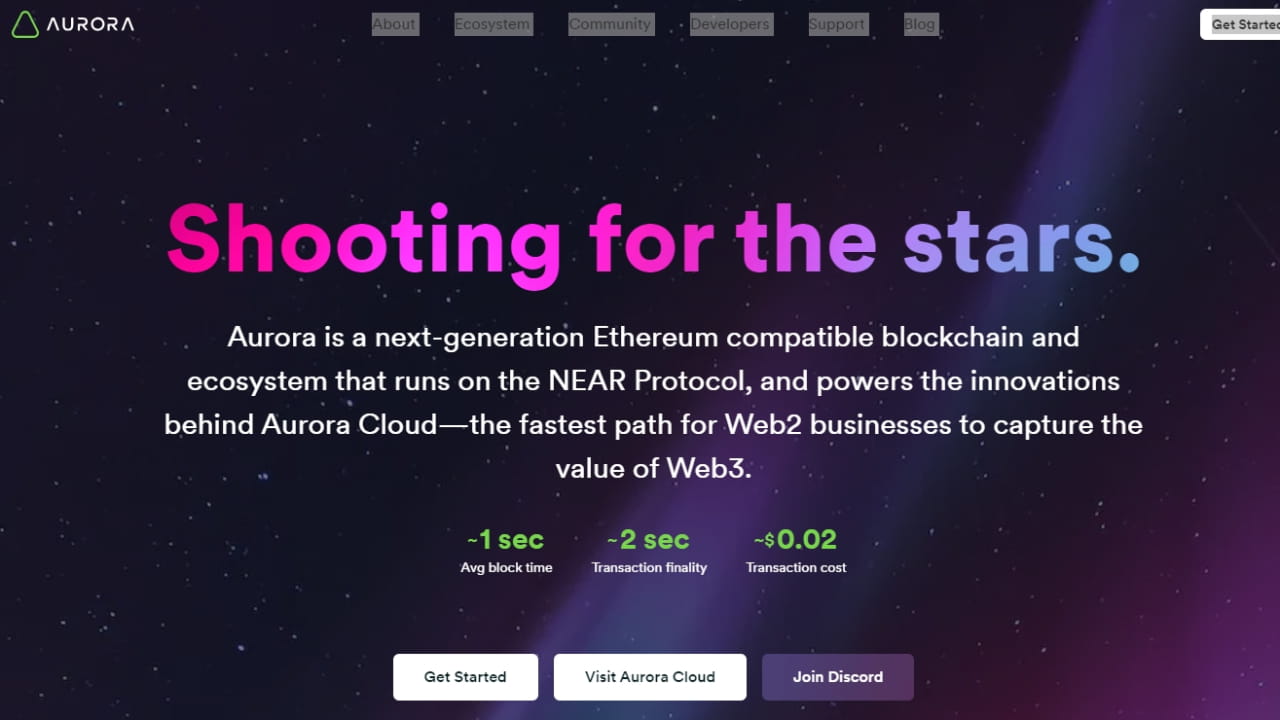
For developers, this means deploying to Aurora is effectively deploying to NEAR, but with the Ethereum developer experience. The network processes transactions using NEAR's block production, ensuring finality and consistency without the overhead of managing a separate L1 consensus layer.
This structure positions Aurora as an interoperable layer within the NEAR ecosystem, rather than a competing chain. It bridges the gap between Ethereum's vast developer community and NEAR's technical performance, offering a unified environment for building scalable dApps.
Market performance and token metrics
Understanding Aurora’s current market position requires looking beyond the technical architecture of its Virtual Chain. While the infrastructure offers a compelling bridge between Ethereum and NEAR, the token itself operates within the volatile realities of the broader crypto market. Grounding the technical discussion in real-world asset performance helps clarify the practical stakes for developers and investors alike.
The AURORA token serves as the economic backbone for the ecosystem, facilitating transaction fees and governance. Its value is intrinsically linked to the adoption of the Virtual Chain model, which allows Solidity smart contracts to run natively on NEAR. This unique positioning creates a distinct liquidity profile compared to standalone L1s or generic L2s, as its utility is tied to cross-chain interoperability and NEAR’s growing ecosystem.
Current price action reflects the market’s assessment of this hybrid approach. Traders watch the AURORA/USD pair closely, as movements often correlate with NEAR’s performance rather than just Ethereum’s. This correlation highlights the importance of monitoring both chains when evaluating Aurora’s health. The following chart provides a one-year technical perspective on this price action, illustrating the volatility and trends that define its current market cycle.
Virtual Chains: Custom EVM Environments on NEAR
Aurora’s infrastructure distinguishes itself through "Virtual Chains." These are fully customizable, EVM-compatible chains that function as smart contracts on the NEAR Protocol. Rather than launching separate Layer 1s or Layer 2s with independent consensus mechanisms, developers can spin up dedicated execution environments that leverage NEAR’s high speed and low costs. This architecture allows teams to tailor gas models, security parameters, and throughput to specific application needs without managing validator nodes or handling cross-chain bridge risks.
The technical advantage lies in resource isolation. Each Virtual Chain operates as a distinct smart contract on NEAR, ensuring that heavy traffic on one chain does not congest others. Developers can configure these environments to support specific use cases, from high-frequency DeFi trading to NFT marketplaces, while benefiting from NEAR’s Proof-of-Stake security. This approach simplifies deployment significantly, as the underlying consensus and finality are handled by the NEAR network.
To understand how Aurora Virtual Chains compare to traditional Layer 2 solutions, consider the following breakdown:
| Feature | Aurora Virtual Chain | Traditional L2 |
|---|---|---|
| Consensus | NEAR PoS (shared) | Independent (e.g., Optimism, Arbitrum) |
| Deployment | Smart Contract (fast) | Complex (validator setup) |
| Security | Inherited from NEAR | Own validator set |
| Cost | Low (NEAR gas) | Variable (often higher) |
This model reduces friction for developers who want to launch specialized chains without the operational burden of maintaining separate infrastructure. By treating each Virtual Chain as a smart contract, Aurora enables a more flexible and efficient ecosystem where applications can scale independently while remaining anchored to a secure, high-performance base layer.
Developer onboarding and tooling
Aurora operates as a virtual chain on the NEAR Protocol, meaning it functions as an Ethereum Virtual Machine (EVM) environment without requiring a separate blockchain layer. This architecture allows developers to deploy existing Ethereum smart contracts with minimal changes, leveraging NEAR's sharding for high throughput while maintaining full EVM compatibility.
The onboarding process is straightforward because the infrastructure is designed to feel familiar. If you have built on Ethereum, you already know the tooling. The key is understanding how to configure your environment to point to the Aurora network and how to manage gas fees, which are paid in NEAR tokens rather than ETH.
1. Configure your development environment
Start by adding the Aurora network to your wallet (such as MetaMask) or your local node configuration. You will need the RPC endpoint, chain ID, and currency symbol (NEAR). This step ensures your development tools can communicate with the Aurora network. Official network parameters are available in the Aurora documentation.
2. Write and compile smart contracts
Use standard Solidity compilers and frameworks like Hardhat or Foundry. Since Aurora is EVM-equivalent, your existing contracts should compile without modification. However, be mindful of gas costs, which are significantly lower on Aurora than on Ethereum mainnet. This efficiency allows for more complex logic without the prohibitive costs seen on other networks.
3. Deploy to the testnet
Before moving to mainnet, deploy your contract to the Aurora testnet. This is where you can verify functionality without risking real assets. Use a faucet to obtain test NEAR tokens for gas fees. Testing on the testnet helps you identify any network-specific issues early in the development cycle.
4. Verify and interact on mainnet
Once your contract is tested, deploy it to the Aurora mainnet. Use Aurorascan to verify your source code and interact with your contract. Aurorascan provides a reliable interface for viewing transactions, contract states, and network activity, similar to Etherscan but optimized for Aurora's infrastructure.
5. Monitor and maintain
After deployment, monitor your contract's performance and gas usage. Aurora's high throughput means you can handle more transactions per second, but you should still optimize your code for efficiency. Regular audits and updates ensure your application remains secure and performant as the network evolves.
-
Network config: RPC, chain ID, and currency symbol added to wallet
-
Gas estimation: Verify NEAR token balance for transaction fees
-
Testnet verification: Deploy and test all contract functions on testnet
-
Source code: Ensure Solidity version compatibility with Aurora EVM
-
Mainnet deployment: Deploy to mainnet and verify on Aurorascan
Cross-Chain NFT Interoperability and Future Roadmap
Aurora’s architecture allows developers to build Ethereum-compatible applications on the NEAR network, but its most distinct utility lies in bridging the gap between these two ecosystems. While most cross-chain solutions rely on wrapped tokens that can feel disconnected from their originals, Aurora is building toward a system where NFTs can move freely between NEAR and Ethereum. This isn't just about moving files; it's about maintaining the asset's identity and utility across different blockchain environments.
The primary value proposition here is accessibility. NEAR offers significantly lower transaction costs and faster finality compared to Ethereum Mainnet. By enabling NFTs to switch between these networks, Aurora aims to solve the friction that often prevents mass adoption. Users could mint or trade on NEAR for speed and low fees, then interact with the same asset on Ethereum where liquidity and major marketplaces reside.
According to official documentation and recent roadmap updates, Aurora intends to enable this seamless switching capability in the near future. This functionality will vastly improve the usefulness and accessibility of NFTs, allowing for a greater range of interactions and transactions across various blockchain networks. It transforms the NFT from a static asset on one chain into a portable asset that can leverage the best features of multiple ecosystems.
This strategy positions Aurora not just as a scaling solution, but as a critical infrastructure layer for the broader NFT market. By reducing the cost of entry and increasing the fluidity of digital assets, Aurora is addressing a key pain point for both creators and collectors. The goal is to create an environment where the underlying blockchain choice becomes less of a barrier and more of a background utility.
Common questions about Aurora EVM
The name "Aurora" creates confusion in search results, often mixing up the NEAR Protocol blockchain with unrelated technologies. This section clears up the most frequent misconceptions and clarifies how the ecosystem actually functions for developers and users.
No comments yet. Be the first to share your thoughts!