How Aurora EVM works under the hood
Aurora is not a standalone blockchain; it is an Ethereum Virtual Machine (EVM) implementation running directly as a smart contract on the NEAR Protocol. This architecture, known as Aurora Engine, allows developers to deploy Ethereum-compatible smart contracts without migrating to a new consensus layer or rewriting code for a different runtime environment [src-serp-5].
By operating as a contract on NEAR, Aurora leverages NEAR’s Nightshade sharding mechanism to process transactions. This setup provides Ethereum compatibility while utilizing NEAR’s high-throughput infrastructure. The result is a network that can handle significantly higher transaction volumes than Ethereum’s base layer, addressing scalability bottlenecks inherent to traditional EVM chains [src-serp-1].
This structure creates what Aurora calls "Virtual Chains." These are fully customizable, EVM-compatible chains that inherit NEAR’s speed and security. Developers can spin up these chains to isolate specific applications or user bases, gaining the scalability and speed needed for high-frequency decentralized applications.
The technical implication is a hybrid model: Ethereum’s developer ecosystem and tooling meets NEAR’s parallel processing capabilities. This eliminates the need for complex cross-chain bridges for basic EVM operations, as the EVM logic executes natively within the NEAR state.
How Aurora's infrastructure upgrades drive scalability
Aurora solves the Ethereum congestion problem by running as a Layer 2 solution on top of the NEAR Protocol. Instead of relying solely on Ethereum's base layer for execution, Aurora utilizes NEAR's Nightshade sharding to process transactions in parallel. This architectural shift allows developers to deploy fully customizable, EVM-compatible chains that operate as smart contracts on NEAR, effectively decoupling execution speed from Ethereum's block times [[src-serp-1]].
The core of this scalability is the concept of "Virtual Chains." These are not separate physical networks but rather isolated execution environments that share NEAR's underlying sharded infrastructure. By running as smart contracts, Virtual Chains inherit NEAR's high throughput and low latency while maintaining full compatibility with Ethereum tooling. This means developers can deploy existing Ethereum applications without rewriting their code, while benefiting from significantly lower gas fees and faster finality [[src-serp-7]].
This infrastructure design fundamentally changes the cost structure for on-chain activity. Where Ethereum L1 requires users to compete for block space during peak times, Aurora's Virtual Chains distribute load across NEAR's sharded network. The result is a consistent, low-cost environment that scales with user demand rather than capping it. For financial applications requiring high-frequency trading or complex DeFi interactions, this reduction in latency and cost is not just an optimization—it is a prerequisite for usability.
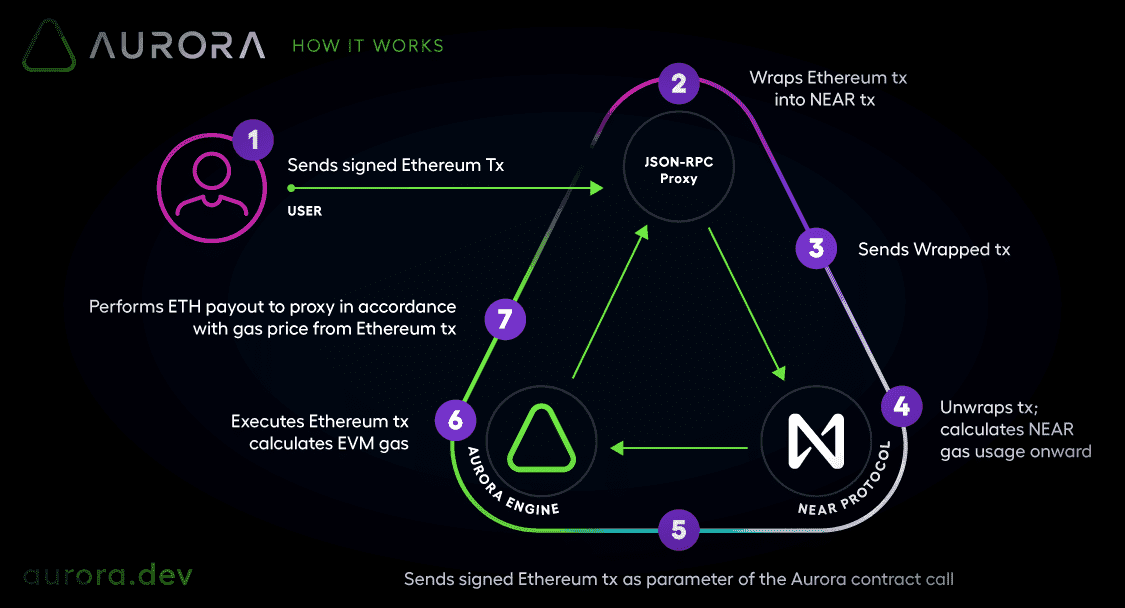
The technical advantage of this setup is visible in the network's ability to handle concurrent transactions. NEAR's Nightshade sharding splits the network state into shards, each processed by a subset of validators. Aurora's Virtual Chains map their execution to these shards, allowing multiple chains to process transactions simultaneously without interfering with each other. This parallel processing capability ensures that network congestion on one Virtual Chain does not slow down activity on another, providing a stable environment for high-stakes financial operations.
Aurora's position in the layer 2 market
Aurora occupies a distinct niche within the layer 2 landscape by functioning as a Virtual Chain on NEAR Protocol. Unlike many competitors that rely on optimistic or zero-knowledge rollups anchored to Ethereum's data availability, Aurora leverages NEAR's sharded architecture to deliver an EVM environment. This structural difference allows Aurora to bypass the inherent bottleneck of Ethereum's block space, offering a path to scalability that is fundamentally tied to the NEAR ecosystem's growth.
The strategic value of this NEAR-native integration becomes apparent when comparing Aurora's performance metrics against other major layer 2 solutions. By utilizing NEAR's proof-of-stake consensus and sharding, Aurora achieves high throughput and rapid finality without the latency often associated with L1 settlement. This architecture supports a robust developer ecosystem, providing tools like AURORASCAN that mirror the functionality of Etherscan while adapting to NEAR's unique infrastructure.
The following comparison highlights how Aurora's technical specifications stack up against Ethereum's base layer and other prominent layer 2 networks. These metrics underscore Aurora's capability to handle high transaction volumes with minimal cost, a critical factor for developers building high-frequency applications.
| Network | Consensus Model | Finality Time | Relative Cost |
|---|---|---|---|
| Aurora | NEAR Proof-of-Stake | ~1-2 seconds | Very Low |
| Ethereum L1 | Proof-of-Stake | ~12-15 minutes | High |
| Arbitrum One | Optimistic Rollup | ~7 days (challenge period) | Low |
| Optimism | Optimistic Rollup | ~7 days (challenge period) | Low |
This data illustrates the trade-offs in the current market. While other layer 2s prioritize security through extended challenge periods, Aurora prioritizes speed and cost-efficiency by settling on NEAR. For users and developers seeking an EVM-compatible chain that does not inherit Ethereum's congestion, Aurora offers a compelling alternative. The ecosystem's continued expansion, driven by this technical edge, positions Aurora as a significant player in the broader Web3 infrastructure market.
Strategic use cases for developers
Aurora’s architecture as a "virtual chain" on NEAR creates a specific niche for applications that need Ethereum compatibility without Ethereum’s congestion. By running as a smart contract on NEAR, Aurora offers high throughput and near-instant finality. This makes it particularly suitable for developer workloads where latency and fee predictability directly impact user experience.
High-frequency trading and DeFi
For decentralized finance applications, speed is a feature. Aurora’s low block times allow for high-frequency trading strategies that are often too expensive or slow on mainnet Ethereum. The ability to execute complex swaps and arbitrage opportunities with minimal slippage and negligible gas fees makes it a viable infrastructure layer for active DeFi protocols.
Gaming and real-time interactions
Blockchain gaming requires transaction speeds that match player expectations. Aurora’s integration with NEAR allows for real-time state updates, enabling game mechanics that react instantly to user actions. This reduces the friction of waiting for block confirmations, a common pain point in other EVM-based gaming ecosystems.
Cost-effective scaling
The economic model of Aurora supports high-volume, low-value transactions. Developers building applications that rely on frequent micro-transactions—such as in-game economies or social tipping—benefit from the low cost per transaction. This accessibility opens up use cases that are economically unviable on higher-fee L1s.
Common questions about Aurora EVM
The Ethereum Virtual Machine (EVM) is the software platform that allows smart contracts to execute, but it is not the same as the Ethereum protocol itself. Ethereum defines the network rules, while the EVM provides the runtime environment where those contracts live. Aurora operates as a virtual chain that brings this same EVM environment to the NEAR blockchain, enabling cross-chain compatibility without reinventing the underlying technology.
No comments yet. Be the first to share your thoughts!