Aurora evm limits to account for
Aurora operates as a fully EVM-compatible layer on NEAR, but this compatibility comes with specific architectural constraints that differ from Ethereum or Arbitrum. Understanding these differences is critical for developers migrating Solidity code or optimizing gas efficiency in 2026.
Transaction Finality
Unlike Ethereum, where blocks are finalized after several confirmations, Aurora leverages NEAR’s Nightshade sharding for near-instant finality. Transactions are typically confirmed within seconds. However, this speed introduces a unique risk: if the NEAR network experiences a deep reorg, Aurora transactions can be invalidated. Developers building high-value DeFi protocols must account for this lower finality threshold compared to L1 Ethereum.
Gas Pricing Mechanism
Aurora uses a hybrid gas model. While you pay for computation in AURORA (the native token), storage costs are measured in NEAR. This dual-token requirement means your deployment strategy must account for NEAR price volatility. Gas limits are generally lower than Ethereum mainnet due to the optimized blockspace, but precise estimation requires testing against Aurora’s specific block gas limits, which are distinct from EIP-1559 dynamics.
State Pruning and History
Aurora does not maintain the same historical state depth as Ethereum. Nodes prune older state data to optimize for speed and storage efficiency. This means you cannot query deep historical data (e.g., events from years ago) using standard RPC endpoints without running a specialized archive node. For most application logic, recent state access is sufficient, but any protocol relying on ancient chain history needs a custom indexing strategy.
Tooling Compatibility
Aurora is fully compatible with standard EVM tools like Hardhat, Truffle, and Foundry. You can deploy the same Solidity contracts used on Ethereum with minimal configuration changes. The primary adjustment is updating your RPC endpoints to Aurora’s mainnet or testnet URLs and ensuring your deployment scripts handle the dual-token gas payment if interacting with NEAR-specific bridges.
Aurora evm choices that change the plan
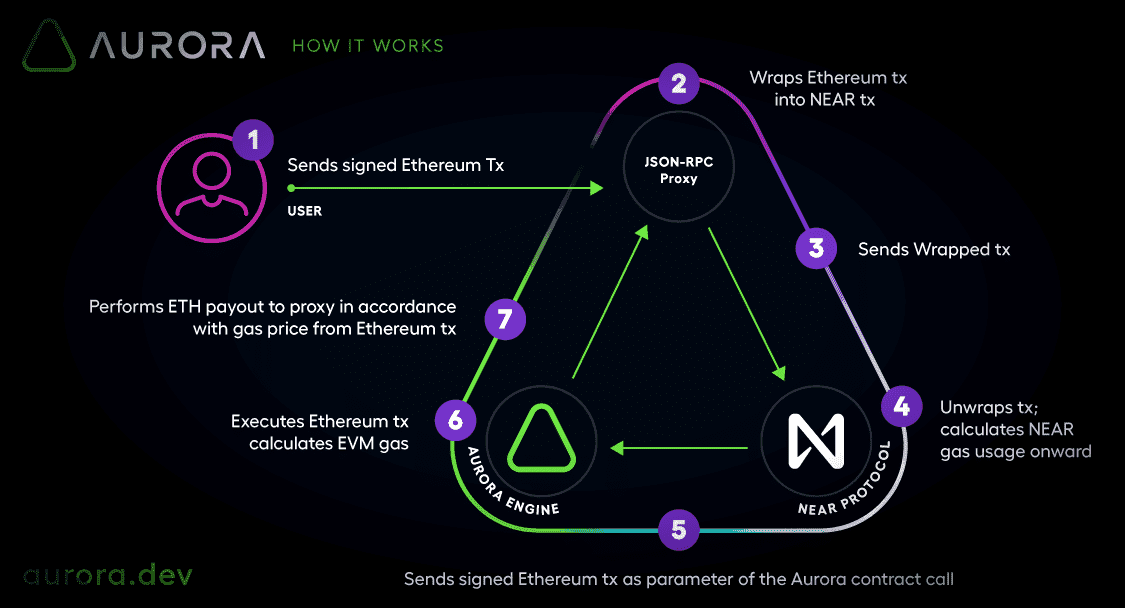
Aurora operates as an Ethereum Virtual Machine (EVM) running on the NEAR Protocol. This architecture offers a distinct set of advantages and compromises compared to standalone Layer 1 chains or standard Ethereum Layer 2s. Evaluating these tradeoffs is essential for developers and investors assessing its role in the 2026 infrastructure landscape.
The primary benefit is EVM compatibility. Aurora allows developers to deploy existing Ethereum smart contracts without modification. You can use familiar tools like Hardhat, Foundry, and Metamask immediately. This lowers the barrier to entry significantly, especially for teams already invested in the Ethereum ecosystem.
However, this compatibility comes with specific transaction cost and speed dynamics. Aurora leverages NEAR’s sharding to achieve high throughput and lower fees than Ethereum Mainnet. Yet, fees are not as negligible as some zero-knowledge rollups. Users pay gas in ETH, which introduces exposure to Ethereum’s price volatility when transacting on Aurora.
Another critical factor is security and decentralization. Aurora relies on NEAR Protocol for finality and security. While NEAR is robust, it is not as battle-tested or decentralized as Ethereum’s Proof-of-Stake consensus. For applications requiring maximum censorship resistance or institutional-grade security guarantees, this shared security model may present a risk.
Finally, consider ecosystem liquidity and interoperability. Aurora benefits from NEAR’s growing user base and cross-chain bridges. However, total value locked (TVL) and developer activity still trail major Layer 2 solutions like Arbitrum or Optimism. Liquidity fragmentation can impact slippage for DeFi protocols deployed on Aurora.
| Factor | Aurora EVM | Standard L2 (e.g., Arbitrum) | Standalone L1 |
|---|---|---|---|
| EVM Compatibility | Full (No code changes) | Full | None or limited |
| Base Fee Token | ETH | ETH | Native (e.g., NEAR, SOL) |
| Security Model | Shared (NEAR Protocol) | Ethereum Finality | Own Consensus |
| Throughput | High (NEAR Sharding) | High | Variable |
| Liquidity Depth | Moderate | Deep | Niche/Fragmented |
The choice depends on your priority. If you need rapid deployment with minimal code changes, Aurora’s EVM alignment is strong. If you require deep liquidity or maximum security, established L2s or L1s may offer better tradeoffs for your specific use case.
Choose the next step
Aurora EVM Analysis works best as a clear sequence: define the constraint, compare the realistic options, test the tradeoff, and choose the path with the fewest hidden costs. That order keeps the advice usable instead of decorative. After each step, pause long enough to check whether the recommendation still fits the reader's actual situation. If it depends on perfect timing, unusual access, or a best-case budget, include a simpler fallback.
Spotting Weak Options and Misleading Claims
Aurora’s promise of full EVM compatibility is real, but the ecosystem still has structural gaps that can trap unwary builders. When evaluating Aurora for 2026, you must distinguish between marketing language and actual infrastructure maturity. Several common claims obscure the real tradeoffs involved in deploying on NEAR’s infrastructure.
The "One-Click" Migration Myth Many platforms claim you can move from Ethereum or other EVM chains instantly. While Aurora supports standard EVM tools like Hardhat, the reality is more complex. You still need to configure RPC endpoints, bridge assets through the official NEAR bridge, and handle potential gas token differences. Assuming a frictionless transfer without testing your specific smart contract interactions first is a costly mistake.
Overlooking the NEAR Dependency Aurora is an EVM layer on NEAR Protocol. This means its finality and security are tied to NEAR’s consensus. If you are building a high-frequency trading application or a system requiring immediate Ethereum-level finality, Aurora’s block times and finality guarantees may not meet your latency requirements. This dependency is a critical architectural decision, not just a minor configuration detail.
Ignoring the Liquidity Fragmentation Liquidity on Aurora is significantly lower than on Ethereum or even established L2s like Arbitrum. This isn't just about total value locked; it's about slippage on DEXs. If your protocol relies on deep order books or large swap volumes, the shallow liquidity pools on Aurora can lead to poor execution prices. Always test your swap volumes against current pool depths before mainnet deployment.
Aurora evm frequently asked: what to check next
Is Aurora compatible with existing Ethereum tools?
Yes. Aurora Mainnet is fully EVM-compatible, meaning you can use standard development stacks like Hardhat and Foundry without modification. Your existing Solidity smart contracts deploy directly to the network, allowing developers to leverage familiar workflows while benefiting from NEAR’s underlying infrastructure.
What is the native gas token on Aurora?
Ether (ETH) serves as the base fee token for transaction costs on Aurora. This design choice simplifies the developer experience by removing the need to acquire a separate native token for gas. You can manage gas fees using the same ETH balances you hold on Ethereum Mainnet.
How does Aurora achieve high throughput?
Aurora runs as a network of "Virtual Chains" on NEAR Protocol rather than operating as a separate Layer 1 or Layer 2 with its own consensus mechanism. This architecture allows Aurora to tap into NEAR’s sharding capabilities, delivering high throughput and scalability for decentralized applications without the overhead of independent block production.
Is Aurora a Layer 2 solution?
Technically, Aurora is an EVM deployed on NEAR that functions similarly to a Layer 2 solution by providing scalability. It utilizes the Rainbow Bridge for asset transfers between Ethereum and NEAR. While it offers L2-like performance and cost efficiency, its underlying consensus is distinct from traditional rollup or sidechain models.
Helpful gear
Use these product recommendations as a starting point, then choose the size, material, and price point that fit how you actually use the gear.


As an Amazon Associate, we may earn from qualifying purchases.
No comments yet. Be the first to share your thoughts!