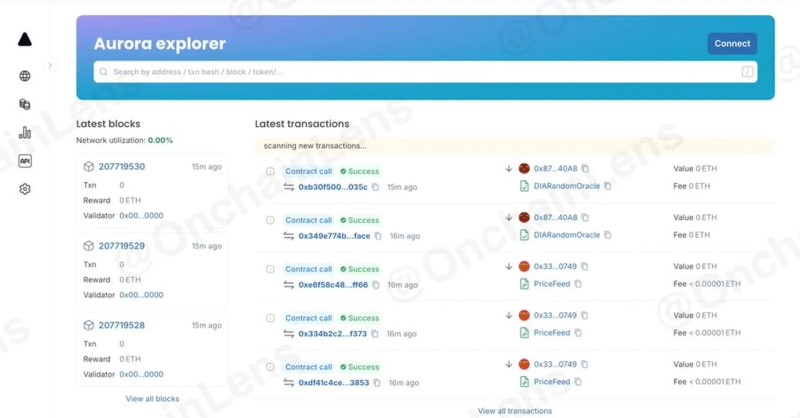
Aurora EVM infrastructure overview
Aurora operates as a Layer 2 solution built directly on the NEAR Protocol, designed to bridge the gap between Ethereum’s developer ecosystem and NEAR’s high-throughput network. By making the Ethereum Virtual Machine (EVM) compatible with NEAR’s sharded architecture, Aurora allows developers to deploy existing Solidity smart contracts and ERC-20 tokens without rewriting code or migrating to a new environment.
The core of this infrastructure is the Virtual Chain architecture. Rather than functioning as a traditional rollup that batches transactions off-chain, Aurora runs as a smart contract on NEAR. This "Virtual Chain" approach enables full EVM compatibility while leveraging NEAR’s Nightshade sharding for scalability. The result is a network that offers the speed and low transaction costs of NEAR while maintaining the security and tooling familiarity of Ethereum.
For the 2026 strategy, this technical foundation is critical. It positions Aurora not just as a scaling layer, but as a native part of the NEAR ecosystem. The integration allows for seamless asset transfers via the Rainbow Bridge and aligns network incentives through AuroraDAO governance. This setup reduces the friction for Ethereum-based dApps looking to scale, offering a direct path to NEAR’s performance without sacrificing EVM interoperability.
Transaction throughput and cost efficiency
Aurora operates as a Layer 2 solution on the NEAR Protocol, designed to bridge the gap between Ethereum’s security and NEAR’s scalability. For developers running high-frequency decentralized applications, the economic difference between Ethereum L1 and Aurora is not just a margin—it is a structural advantage. While Ethereum L1 processes transactions through a consensus mechanism that prioritizes security over speed, Aurora leverages NEAR’s Nightshade sharding to handle throughput at a fraction of the cost.
The primary benefit for dApps is the dramatic reduction in gas fees. On Ethereum L1, transaction costs fluctuate wildly based on network congestion, often making micro-transactions or high-frequency trading economically unviable. Aurora’s architecture decouples execution from settlement, allowing it to maintain consistent, low-cost fees regardless of global network demand. This stability is critical for DeFi protocols that require predictable operational costs to maintain liquidity and user engagement.
To understand the scale of this efficiency, it helps to compare the raw metrics of transaction costs and throughput across the major networks. The following table illustrates the stark contrast between Ethereum L1, Aurora, and other prominent Layer 2 solutions.
| Network | Avg. Gas Cost (USD) | Throughput (TPS) | Finality Time |
|---|---|---|---|
| Ethereum L1 | 1.50 - 25.00 | 15 - 30 | ~12-15 min |
| Aurora (NEAR L2) | 0.001 - 0.01 | 1,000+ | ~1-2 sec |
| Arbitrum One | 0.10 - 0.50 | 40 - 45 | ~10-20 min |
| Optimism | 0.10 - 0.40 | 30 - 40 | ~10-20 min |
| Polygon PoS | 0.001 - 0.01 | 6,500 | ~2-3 min |
The data shows that Aurora’s gas costs are roughly two to three orders of magnitude lower than Ethereum L1. While Polygon PoS also offers low fees, Aurora’s integration with NEAR’s sharding provides a different security model and interoperability with the NEAR ecosystem, which is increasingly becoming a hub for high-performance dApps. For applications that rely on frequent state updates, such as gaming or real-time trading platforms, Aurora’s sub-cent transaction costs remove the friction that typically limits user adoption on Ethereum.
This cost efficiency does not come at the expense of Ethereum compatibility. Aurora is fully EVM-compatible, meaning existing Solidity smart contracts can be deployed with minimal modification. This reduces the development overhead and allows teams to leverage the vast ecosystem of Ethereum tools while benefiting from NEAR’s underlying performance. As the Layer 2 landscape matures, the ability to offer near-zero gas fees while maintaining Ethereum’s security guarantees will be a decisive factor for the next generation of decentralized applications.
Technical chart analysis and market trends
Use this section to make the Aurora EVM Analysis decision easier to compare in real life, not just on paper. Start with the reader's actual constraint, then separate must-have requirements from details that are merely nice to have. A practical choice should survive normal use, maintenance, timing, and budget. If a recommendation only works in an ideal situation, call that out plainly and give the reader a fallback path.
The simplest way to use this section is to write down the must-have criteria first, then compare each option against those criteria before weighing nice-to-have features.
Deploying on Aurora EVM
Aurora operates as a Layer 2 solution on NEAR Protocol, providing full EVM compatibility. This means developers can deploy Solidity smart contracts without rewriting code, leveraging NEAR’s sharding for scalability while maintaining Ethereum tooling standards. The architecture functions as a "virtual chain"—a smart contract on NEAR that processes EVM transactions independently, offering high throughput and low latency. For Web3 developers, this creates a straightforward migration path from Ethereum mainnet or other EVM chains.
1. Set up development environment
Aurora is compatible with standard Ethereum development stacks. You can use Hardhat, Truffle, or Foundry with zero configuration changes to the core logic. The primary adjustment involves updating your deployment configuration to point to the Aurora RPC endpoint. Since Aurora is fully EVM-compatible, your existing Solidity code, test suites, and deployment scripts will function identically to how they do on Ethereum, reducing the friction typically associated with multi-chain deployments.
2. Bridge assets using Rainbow Bridge
Before deploying contracts or testing dApps, you need AURORA tokens (NEP-141 standard) for gas. The Rainbow Bridge is the official mechanism for migrating ERC-20 tokens and ETH from Ethereum to Aurora. It uses a lock-and-mint model, ensuring asset integrity during the transfer. Developers should bridge testnet assets first to verify wallet connectivity and transaction finality. The bridge interface is integrated directly into the Aurora ecosystem, simplifying the initial funding process compared to third-party bridge solutions.
3. Deploy and verify contracts
Once funded, deploy your contract to the Aurora mainnet using your preferred IDE. After deployment, verify the source code on the Aurora Explorer to ensure transparency and enable other developers to interact with your contract via the API. Verification is critical for dApp integrations, as it allows frontends to read contract state without needing to parse raw bytecode. Aurora’s explorer provides a user-friendly interface for this process, mirroring the experience of Etherscan.
4. Integrate and test
With your contract deployed, integrate it into your frontend using standard Web3 libraries like ethers.js or web3.js. Test the integration thoroughly on Aurora’s testnet before mainnet launch. Focus on transaction speed and gas cost optimization, as Aurora’s block times are significantly faster than Ethereum’s. Monitor transaction receipts to ensure compatibility with NEAR’s finality model, which differs from Ethereum’s probabilistic finality.
-
Update RPC endpoint to Aurora mainnet URL
-
Bridge AURORA tokens for gas fees
-
Verify contract source code on Explorer
-
Test transaction finality and gas costs
Common questions about Aurora EVM
Investors and developers frequently ask how Aurora fits into the broader NEAR ecosystem. Below are answers to the most common search queries regarding its technology, NFT valuation, and market outlook.
Note: The chart above reflects live market data for Aurora against USDT. Past performance is not indicative of future results.
No comments yet. Be the first to share your thoughts!