How Aurora Runs as a Smart Contract on NEAR
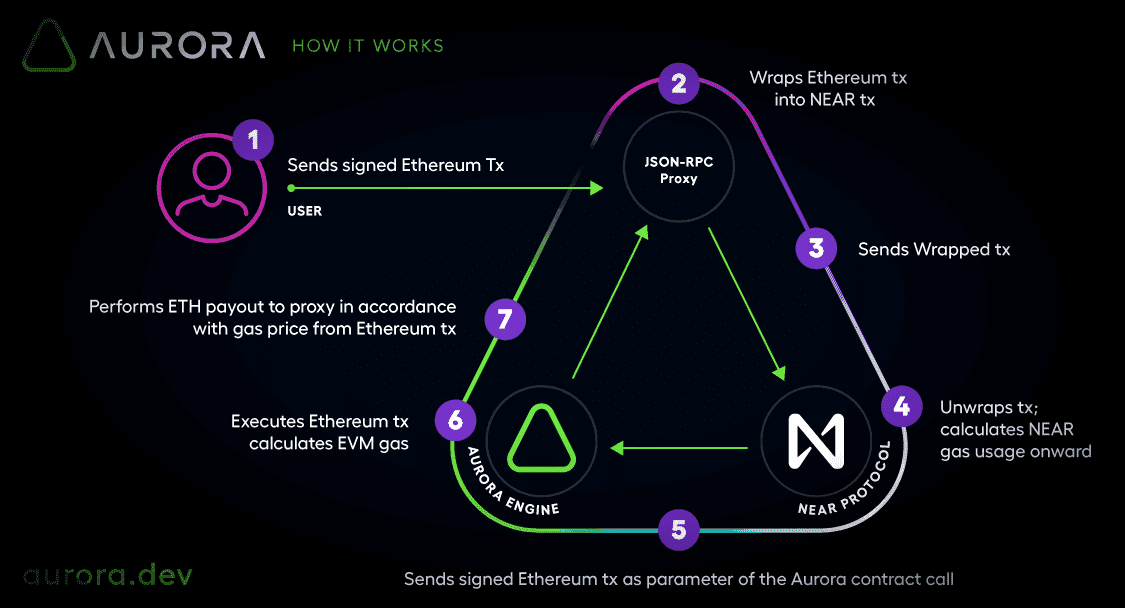
Aurora does not operate as a separate Layer 1 blockchain or a traditional Layer 2 rollup. Instead, it functions as a "virtual chain" that executes directly as a smart contract on the NEAR Protocol. This architectural choice means Aurora inherits NEAR's consensus and security model rather than building its own validator set.
For developers, this distinction is critical. Because Aurora is essentially an EVM-compatible smart contract deployed on NEAR, it bypasses the heavy infrastructure overhead required to maintain a standalone network. You gain full Ethereum Virtual Machine compatibility without the latency and complexity of cross-chain messaging or separate bridge management.
This setup allows Aurora to leverage NEAR's Nightshade sharding for horizontal scaling. The network processes transactions in parallel, offering high throughput and low fees while maintaining the familiar Solidity development environment that Ethereum developers already know. It is a hybrid approach: the flexibility of EVM with the scalability of a sharded Layer 1.
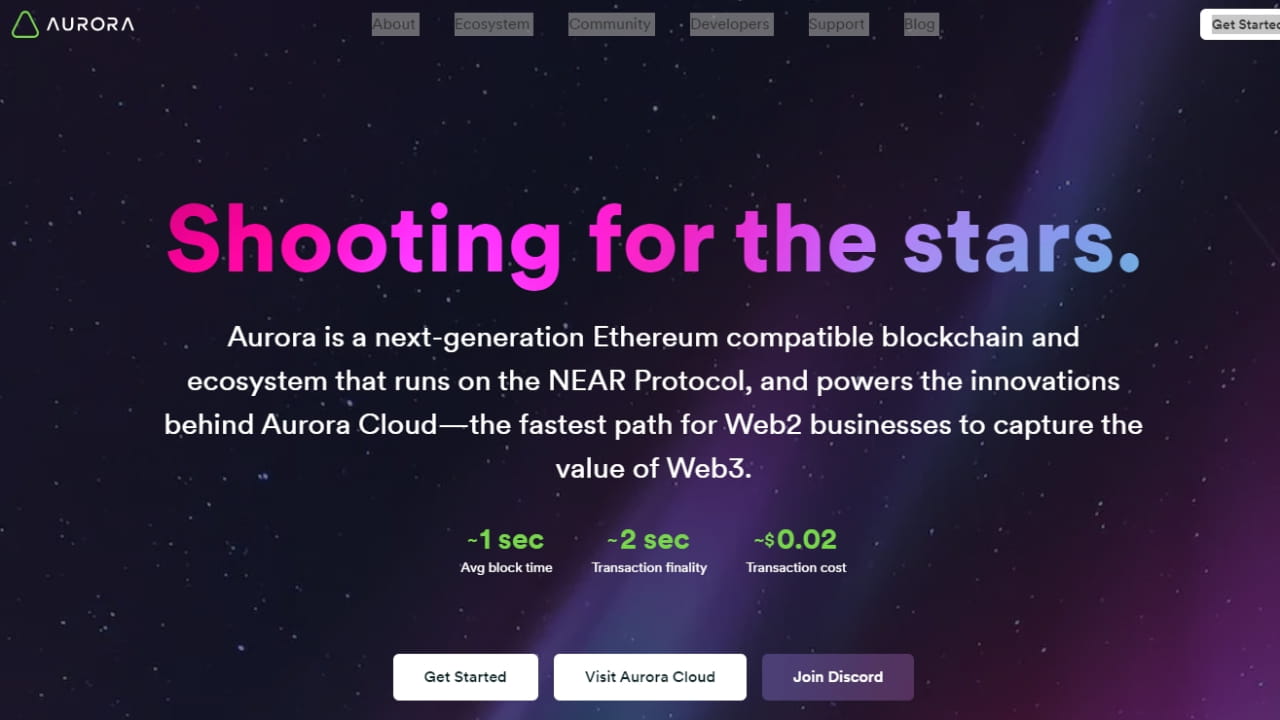
The implications for the ecosystem are tangible. By running on NEAR, Aurora avoids the "island" problem that plagues many L2s, where liquidity and activity are fragmented. Instead, it sits within a larger, active network, drawing from NEAR's user base and developer tools. This integration is why Aurora can offer near-instant finality and negligible gas costs, making it a practical choice for high-frequency DeFi applications.
Aurora Funding and Tokenomics Overview
Aurora operates as an EVM-compatible scaling solution on the NEAR Protocol, bridging Ethereum developers to a high-throughput environment. The project raised $100 million in its public fundraising round, providing the capital necessary to build infrastructure that allows Solidity smart contracts to execute on NEAR's shardable network. This funding underscores the strategic importance placed on interoperability between the two ecosystems.
The AURORA token is central to the network's utility, serving three primary functions: paying for transaction fees, staking for network security, and participating in governance. Unlike purely speculative assets, the token has tangible utility within the NEAR ecosystem. Users stake AURORA to secure the network, while developers use it to cover gas costs, which remain significantly lower than Ethereum's mainnet fees. This structure supports a sustainable model for dApp deployment.
To track real-time market performance, we use provider-backed widgets below. These tools reflect current liquidity and price action without relying on static, potentially outdated data points.
| Feature | Aurora | Ethereum L1 | NEAR L1 |
|---|---|---|---|
| EVM Compatibility | Yes | Yes | No |
| Transaction Finality | ~2 minutes | ~12-15 minutes | ~1 second |
| Fee Structure | Low (ETH-denominated) | High (volatile) | Very Low (NEAR-denominated) |
| Scaling Mechanism | Sidechain | Layer 1 | Nightshade Sharding |
Aurora's position in the market is defined by its role as a bridge. It does not compete directly with NEAR's native functionality but rather extends Ethereum's reach. This strategy attracts developers who need EVM compatibility without Ethereum's congestion. The token's value is tied to the volume of transactions processed on this bridge, making network adoption the key metric for long-term viability.
Essential developer tools and infrastructure
Building on Aurora requires a specific set of utilities that bridge the gap between Ethereum tooling and NEAR’s underlying architecture. Because Aurora Engine implements an Ethereum Virtual Machine (EVM) on NEAR, most standard Ethereum development workflows apply directly. You can use familiar IDEs like VS Code with Hardhat or Foundry, but you must configure your deployment targets to point to Aurora’s RPC endpoints.
For network visibility, Aurorascan serves as the primary block explorer. It mirrors the functionality of Etherscan, providing the necessary data transparency for transaction tracking, contract verification, and token analysis. This parity is essential for developers migrating from Ethereum who rely on established interface patterns. The explorer is maintained by the NEAR Foundation, ensuring alignment with the broader NEAR ecosystem's decentralization goals.
Deployment pipelines benefit from Aurora’s native support for Solidity and Vyper. When you compile and deploy, the transaction is processed through NEAR’s sharding mechanism, which significantly reduces latency compared to base Ethereum layers. However, you should account for the slight difference in gas estimation logic, as Aurora’s gas pricing model is tied to NEAR’s fuel price rather than Ethereum’s ETH market dynamics.
To help you evaluate whether Aurora’s infrastructure fits your project’s needs, the table below compares its core technical attributes against a generic Ethereum L2.
| Feature | Aurora | Generic Ethereum L2 |
|---|---|---|
| Gas Token | NEAR | ETH |
| Block Time | ~1-2 seconds | ~2-3 seconds |
| Compatibility | Full EVM | Full EVM |
| Finality | NEAR Finality | Rollup Finality |
When setting up your development environment, ensure your .env files correctly map the Aurora RPC URLs. This simple configuration step is often overlooked but is critical for avoiding deployment failures. The underlying Aurora Engine code is open-source and available on GitHub, allowing you to audit the exact implementation details if needed.
The chart above tracks NEAR, the native asset powering Aurora’s gas fees. Since Aurora’s transaction costs are denominated in NEAR, monitoring its price action is vital for estimating deployment costs. A spike in NEAR’s price will directly increase your gas expenditures, even if the network load remains stable. Keeping an eye on this metric helps you time your mainnet deployments for lower cost windows.
Strategic considerations for builders
Choosing Aurora for a new Web3 project in 2026 requires weighing immediate developer utility against long-term decentralization risks. For builders, the primary appeal is the EVM compatibility that allows seamless migration of Ethereum smart contracts without rewriting code. This lowers the barrier to entry, enabling teams to leverage existing tooling like Hardhat and Foundry while benefiting from NEAR’s sharding infrastructure for lower fees and higher throughput.
However, this efficiency comes with a centralization trade-off that demands scrutiny. Aurora relies on the NEAR Protocol for consensus and data availability. While this provides robust security, it means Aurora is not a fully independent layer-1 chain. Builders must evaluate whether their users prioritize absolute decentralization or simply fast, cheap transactions. If your project’s value proposition hinges on censorship resistance independent of NEAR, this dependency may be a strategic liability.
User acquisition strategies on Aurora should focus on its technical advantages: speed and cost. The network’s ability to handle complex smart contracts with minimal gas fees makes it attractive for high-frequency applications like gaming or micro-transactions. Yet, market perception plays a role. Some users still associate Aurora with the broader NEAR ecosystem rather than seeing it as a standalone EVM environment. Building a brand that clearly communicates this hybrid advantage can help capture users who want Ethereum compatibility without Ethereum’s congestion.
Ultimately, the decision hinges on your project’s specific needs. If you need a rapid, cost-effective deployment with strong Ethereum compatibility, Aurora is a compelling option. If your users require a fully independent, permissionless settlement layer, you may need to look beyond the NEAR ecosystem. The technology is mature, but the strategic fit depends entirely on your target audience’s tolerance for centralized infrastructure.
Frequently Asked Questions About Aurora EVM
Helpful gear
Use these product recommendations as a starting point, then choose the size, material, and price point that fit how you actually use the gear.


As an Amazon Associate, we may earn from qualifying purchases.
No comments yet. Be the first to share your thoughts!