The Architecture of Virtual Chains
Aurora operates differently from traditional Layer 2 solutions like Optimism or Arbitrum. Instead of running as a separate network secured by its own rollup validity proofs, Aurora is a pure Ethereum Virtual Machine (EVM) implementation that runs directly as a smart contract on the NEAR Protocol blockchain.
This distinction creates what Aurora calls "virtual chains." In this model, the chain itself is not a distinct physical network with its own validators. Rather, it is a piece of code executing on NEAR. This approach allows Aurora to leverage NEAR’s high throughput and low latency while maintaining full compatibility with the Ethereum ecosystem. Developers can deploy standard Solidity contracts without needing to adapt to a new execution environment or bridge assets through complex, multi-step processes.
The underlying engine is a high-performance, pure Rust implementation of the EVM. This design choice prioritizes security and efficiency, ensuring that the execution layer remains robust. By embedding the EVM within NEAR, Aurora eliminates the need for separate sequencers or complex state bridges that often introduce latency and security risks in other Layer 2 architectures.
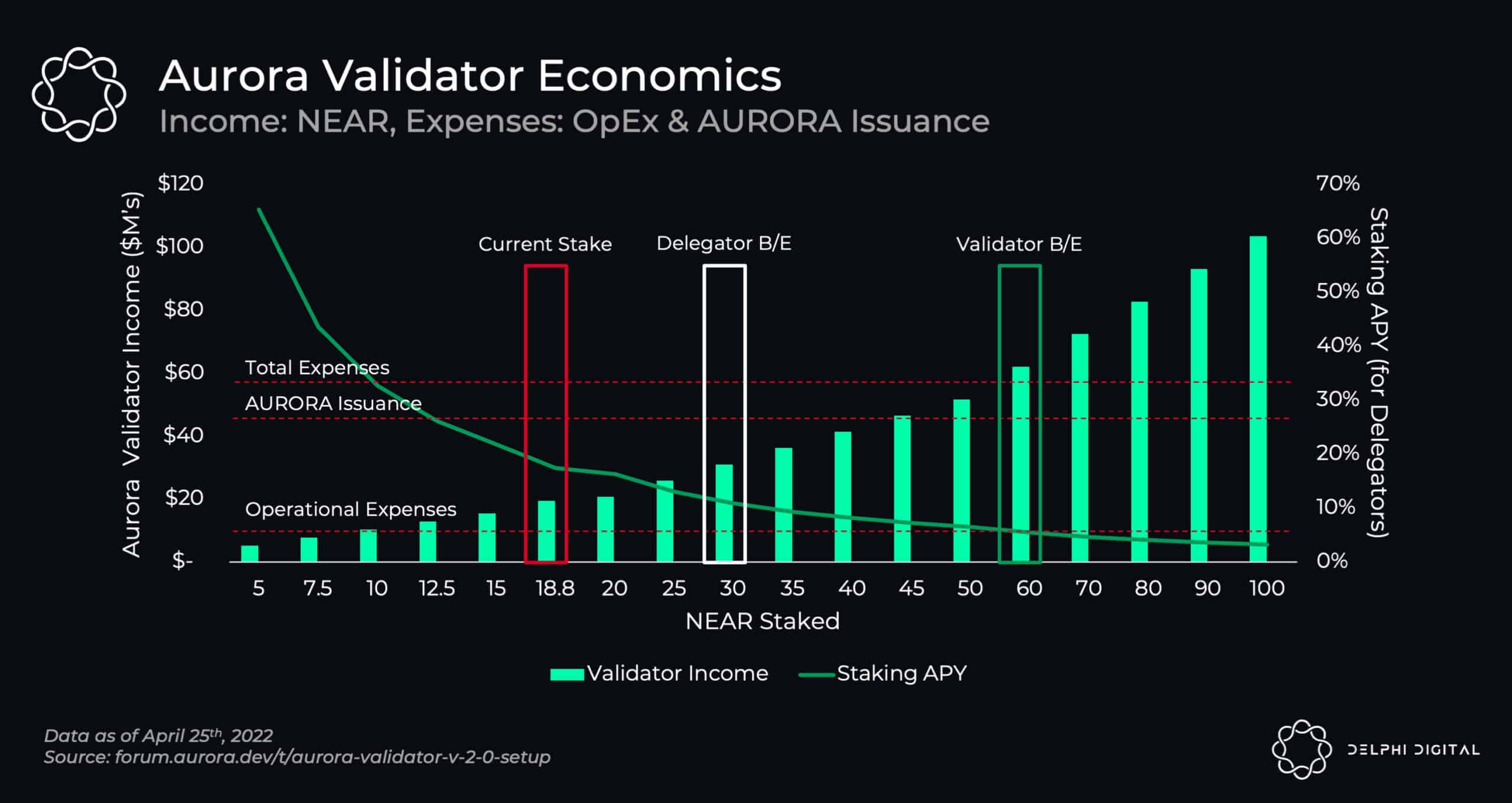
This architecture means that when you interact with an app on Aurora, you are interacting with a contract on NEAR. The benefits are immediate: transaction costs are a fraction of Ethereum mainnet, and finality is near-instant. However, it also means that Aurora’s security is ultimately tied to the consensus of the NEAR network, a trade-off that defines its unique position in the infrastructure landscape.
Market performance and token metrics
The AURORA token operates at the intersection of Ethereum’s developer ecosystem and NEAR’s throughput. As the native asset for the Aurora L2 network, its price action reflects both broader crypto sentiment and specific metrics around network utilization. Understanding these dynamics requires looking past headline volatility to the underlying on-chain activity that drives long-term value.
Aurora functions as a fully EVM-compatible Layer 2 solution built on NEAR Protocol. This architecture allows developers to deploy existing Ethereum smart contracts with minimal changes while benefiting from NEAR’s sharding technology. The result is significantly lower transaction costs and faster finality, positioning Aurora as a practical bridge for Ethereum-based applications seeking scalability without sacrificing compatibility.
From a market perspective, the token’s performance is closely tied to the health of the NEAR ecosystem. While Ethereum Mainnet handles high-value settlements, Aurora absorbs the transactional volume. This division of labor is critical for maintaining low gas fees during periods of high network congestion. Investors and developers monitor these metrics to gauge whether the network is capturing meaningful share of Ethereum’s developer activity.
Live price data and technical indicators provide real-time context for short-term trading decisions. However, the long-term trajectory depends on sustained adoption by dApps and the continuous improvement of Aurora’s virtual chain infrastructure.
Technical analysis tools help identify support and resistance levels for traders. The chart below illustrates recent price movements and volume trends for AURORA against the US Dollar.
Essential development tools and stack
Building on Aurora requires a specific set of tools to navigate its position as an EVM-compatible Layer 2 on NEAR Protocol. The ecosystem supports standard Ethereum development workflows, meaning Solidity contracts and familiar tooling like Hardhat or Foundry work out of the box. However, understanding the underlying infrastructure is critical for performance optimization and cost management.
For node access, developers can choose between self-hosted nodes or managed services. Aurora Cloud offers production-ready virtual chains that inherit NEAR's scalability, providing a robust backend for high-throughput applications. Alternatively, providers like QuickNode offer specialized Aurora endpoints that simplify RPC interactions and handle infrastructure maintenance, allowing teams to focus on application logic rather than node synchronization.
Selecting the right node provider often comes down to reliability requirements and budget. The table below compares common options available to developers deploying on Aurora. Choosing a provider with strong uptime guarantees and low-latency endpoints is essential for dApps that require real-time user interactions.
| Provider | Type | Key Features | Best For |
|---|---|---|---|
| Aurora Cloud | Managed L2 | Full security inheritance, scalable infrastructure | Production-grade applications |
| QuickNode | Node Provider | High uptime, specialized endpoints | Rapid development and testing |
| Self-hosted | Self-managed | Full control, customizable | Advanced customization needs |
Hardware for node operators and miners
Running an Aurora node requires infrastructure that prioritizes high-speed storage and consistent compute throughput. Because Aurora is a pure Rust implementation of the Ethereum Virtual Machine (EVM) built on the NEAR Protocol, its resource demands differ slightly from traditional Ethereum mainnet nodes. The primary bottleneck for most operators is not raw CPU power, but the ability to ingest and store state data at scale.
Storage and Compute Essentials
For storage, NVMe SSDs are non-negotiable. The Aurora node syncs rapidly, and mechanical hard drives will create a backlog that prevents the node from staying current with the network. Aim for at least 2TB of fast storage to accommodate the growing state database. On the compute side, a modern multi-core CPU with high single-thread performance helps manage the EVM execution layer efficiently.
The Aurora EVM client is designed for efficiency, but network synchronization remains the most resource-intensive phase. During the initial sync, ensure your server has ample RAM (32GB+) to handle the state trie operations without swapping. Once synced, a stable 100Mbps+ internet connection is critical to keep up with the block propagation on NEAR.
Recommended Hardware Setup
To help you build a reliable node, here are the core hardware components typically recommended for this workload. These selections focus on durability and throughput rather than gaming or consumer-grade features.


As an Amazon Associate, we may earn from qualifying purchases.
The Aurora Labs documentation provides specific configuration guidelines for these components. Always refer to the official GitHub repository for the latest client requirements, as network upgrades may shift the baseline hardware needs over time.
The Future of Aurora Scaling
Aurora is positioning itself as the foundational infrastructure for a new wave of blockchain development. By leveraging its EVM compatibility, it allows developers to deploy existing Ethereum tooling directly onto the NEAR Protocol, significantly reducing costs while maintaining performance. This approach is central to the concept of "virtual chains," where multiple independent EVM environments can coexist within a single shared security model.
The strategic advantage lies in this modularity. Instead of forcing every application to choose between high fees on Ethereum L1 or fragmented liquidity across various L2s, Aurora offers a unified layer. As the ecosystem matures, we expect to see a proliferation of these virtual chains, each tailored to specific verticals like gaming or DeFi, yet all benefiting from NEAR’s underlying sharding technology. This structure supports a more scalable and accessible Web3 landscape without sacrificing developer familiarity.
Monitoring Aurora’s growth involves tracking the adoption of this virtual chain model rather than just token price movements. The focus should remain on network utility, developer activity, and the successful deployment of high-throughput applications. As the infrastructure stabilizes, Aurora’s role as a bridge between Ethereum’s ecosystem and NEAR’s speed could become increasingly critical for mainstream blockchain adoption.
Common questions about Aurora
What is the Aurora blockchain?
Aurora is a Layer 2 blockchain solution built on the NEAR Protocol that provides Ethereum Virtual Machine (EVM) compatibility with enhanced scalability and significantly lower transaction costs. It allows developers to deploy existing Ethereum smart contracts and tools directly on NEAR without modification, effectively bridging the two ecosystems (Quicknode).
What happened to Aurora Crypto today?
Market data indicates that the price of AURORA has decreased today. Currently, 1 AURORA costs approximately £0.020, representing a change of +0.05% in the last hour and a change of -1.49% in the last 24 hours (Revolut).
Are Aurora NFTs a good investment?
Aurora holds potential as an investment due to its role as an Ethereum-compatible solution on the NEAR blockchain, but its long-term viability depends on adoption, ecosystem growth, and market conditions (Godex).
No comments yet. Be the first to share your thoughts!